Automatic Powder Mixing Line with IBC Bin Mixer
Hywell Machinery provides complete automatic powder mixing lines for pharmaceutical, nutraceutical, food, chemical, and specialty powder production.
The complete system integrates raw material feeding, weighing and batching, powder conveying, IBC bin mixing, closed discharge, IBC washing, and drying into one coordinated production process.
An IBC-based powder mixing line helps manufacturers reduce manual material handling, minimize dust emissions and cross-contamination risks, simplify product changeover, and improve overall production efficiency.
Typical Process:
Raw Material Feeding → Weighing & Batching → Powder Conveying → IBC Bin Mixing → Closed Discharge → IBC Washing → IBC Drying
Request a Customized Powder Mixing Line
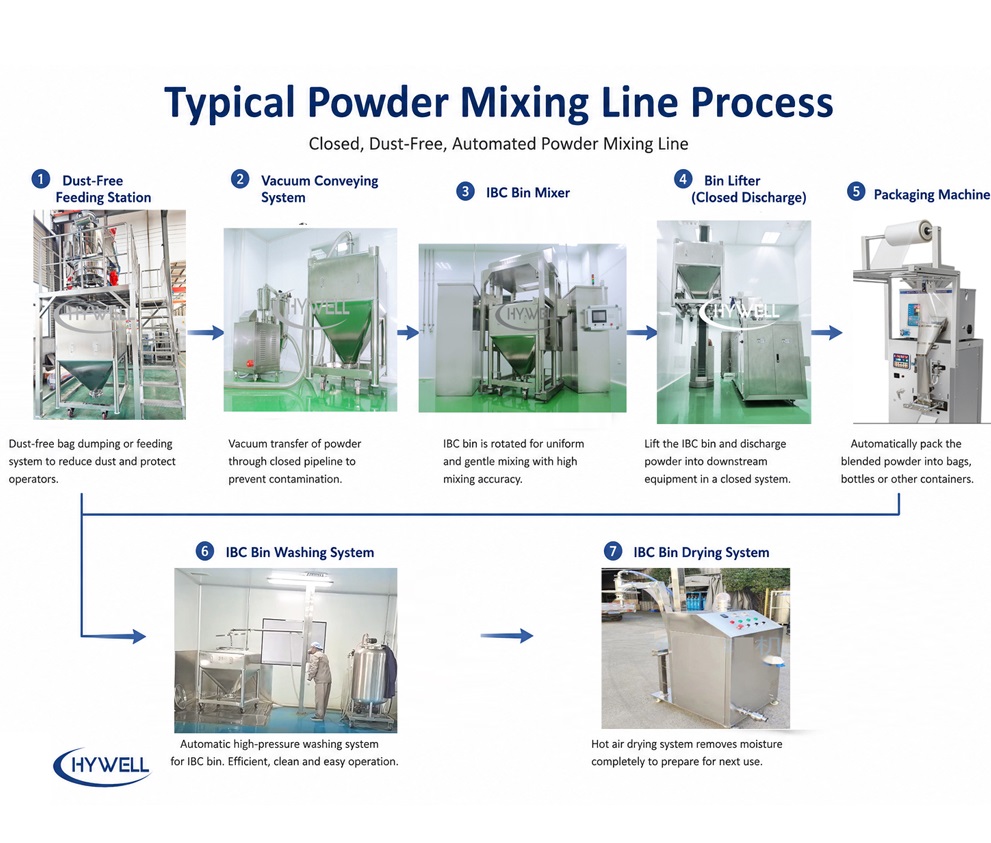
Complete Powder Mixing & Blending System
In modern powder processing industries, product quality depends not only on the performance of the mixer but also on the efficiency of the entire production process. Manual handling, open material transfer, dust generation, and difficult cleaning procedures can lead to contamination risks, inconsistent product quality, and increased labor costs.
A Powder Mixing Line integrates feeding, conveying, blending, discharge, cleaning, and drying into a complete automated system. It provides a closed, dust-free, and efficient production process suitable for nutraceutical, pharmaceutical, food, chemical, and specialty powder applications.
2. At Hywell Machinery, we provide complete Powder Mixing Line Solutions that combine dust-free feeding systems, vacuum conveying, IBC bin mixers, bin lifting systems, washing stations, and drying equipment into a fully integrated production line.
What Is a Powder Mixing Line?
A Powder Mixing Line is a complete processing system designed to receive raw materials, transfer them automatically, blend them uniformly, discharge finished products, and clean the containers for the next batch.
Unlike a standalone powder mixer, a complete powder mixing line focuses on the entire production workflow, ensuring:
Dust-free operation
Closed material handling
Consistent mixing quality
Reduced labor requirements
GMP-compliant production
Easy cleaning and product changeover
This system is particularly suitable for manufacturers producing multiple powder formulations with varying batch sizes and requiring frequent product changeovers.
How Does an Automatic Powder Mixing Line Work?
A typical automatic powder mixing line consists of several integrated processing stages. The exact configuration depends on the customer's formulation, production capacity, and cleaning requirements.
1. Automatic Powder Weighing and Batching
For formulations containing multiple raw materials, an automatic weighing and batching system can be integrated before the mixing stage.
The system can be designed to weigh different ingredients according to a predefined recipe and transfer the materials to the mixing process.
A typical automatic batching process is:
Raw Material Storage → Weighing → Transfer → IBC Mixing
The weighing system can be customized according to:
For projects requiring a complete automatic powder production system, Hywell can integrate the weighing, feeding, conveying, and mixing processes into one control system.
2. Raw Material Conveying
Efficient and hygienic material feeding is the first step in any powder mixing line. Depending on production capacity, cleaning requirements, and product changeover frequency, different feeding solutions can be selected.
All Hywell powder mixing lines utilize a Dust-Free Feeding Station to minimize dust emissions, improve workplace cleanliness, and protect operators during material loading.
Key Benefits of Dust-Free Feeding Stations
Negative pressure dust collection
Cleaner production environment
Reduced material loss
Improved operator safety
GMP-compliant design
Easy cleaning and maintenance
To transfer raw materials into the IBC bin mixer, two feeding methods are commonly used.
Feeding Method Selection Guide for Powder Blending Line
Item | Dust-Free Feeding + Vacuum Conveying | Dust-Free Feeding + Hopper Lifter |
Dust Control | Excellent | Excellent |
Material Transfer | Fully Automatic | Semi-Automatic |
Production Capacity | High | Medium |
Cleaning Time | Longer | Shorter |
Product Changeover | Moderate | Excellent |
Material Retention | Possible in Pipeline | Minimal |
Cross-Contamination Risk | Low | Very Low |
Suitable for Frequent Formula Changes | No | Yes |
Recommended Industries | Food, Chemical | Nutraceutical, Pharmaceutical |
Recommendation: For nutraceutical powder production, such as collagen, creatine, protein powder, and dietary supplements, the Dust-Free Feeding Station + Hopper Lifter solution is often the preferred choice because it minimizes product retention and simplifies cleaning during frequent product changeovers. |
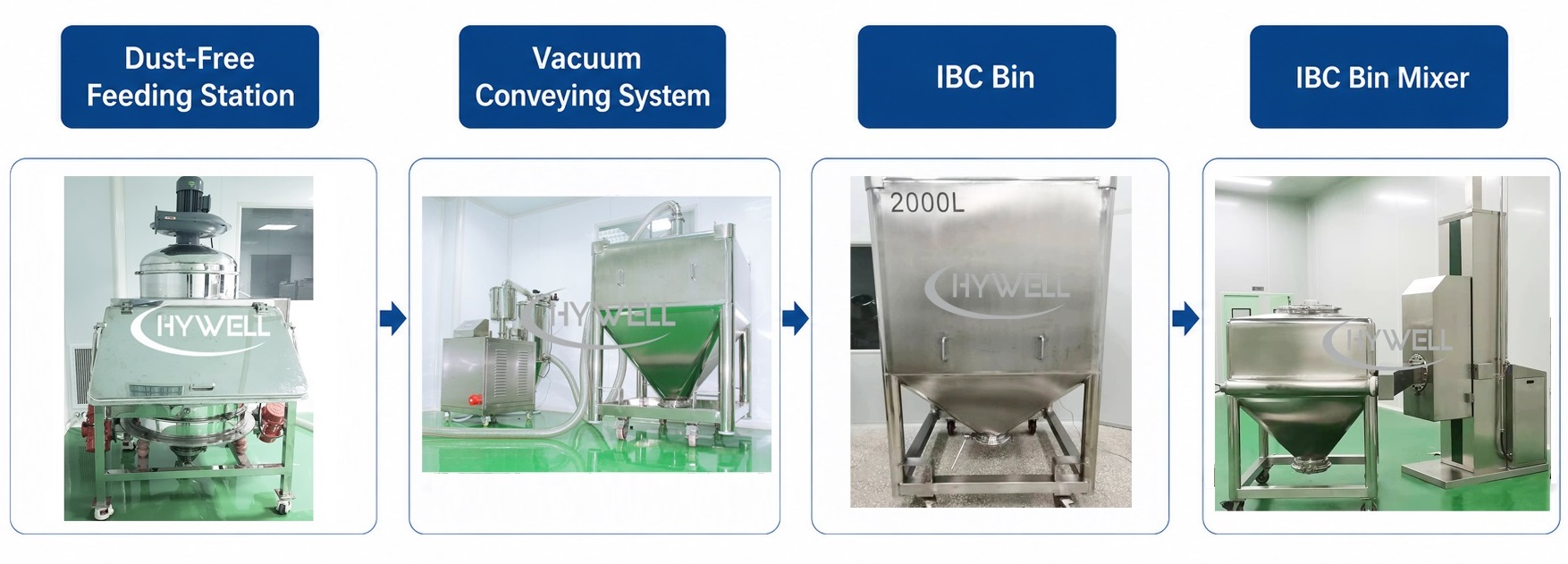
Option 1: Dust-Free Feeding Station + Vacuum Conveying System
For high-volume production and applications with relatively stable formulations, a vacuum conveying system can be integrated with the dust-free feeding station.
Process
Advantages
Fully enclosed powder transfer
No airborne dust
Reduced manual handling
High production efficiency
Suitable for long-distance material transfer
Ideal for continuous production
Note: For products requiring frequent recipe changes, residual powder may remain inside the conveying pipeline, resulting in additional cleaning and validation work.
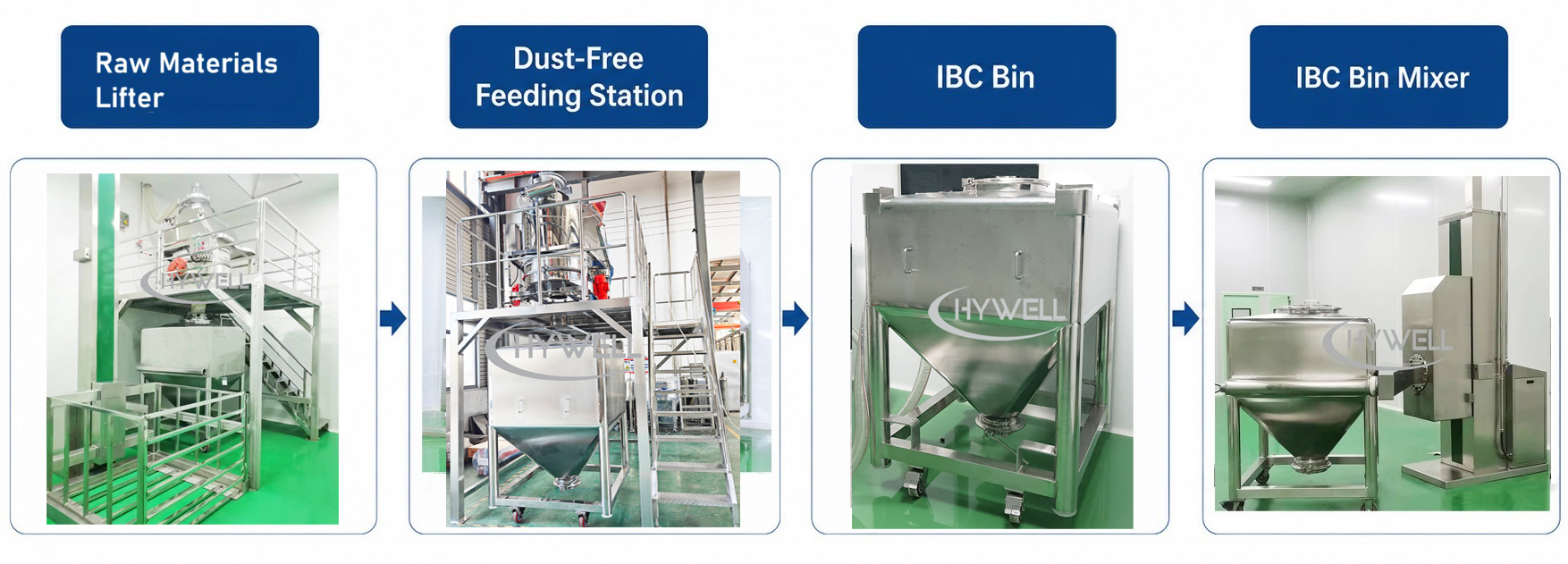
Option 2: Dust-Free Feeding Station + Raw Materials Lifter
For nutraceutical and pharmaceutical production with frequent formula changes, a raw materials lifting system is often the preferred solution.
Process
Advantages
No conveying pipeline residue
Faster cleaning and changeover
Reduced cross-contamination risk
Lower cleaning validation workload
Ideal for multi-product manufacturing
Note: Because materials are discharged directly into the IBC bin through the dust-free feeding station, there is virtually no product retention, making cleaning significantly easier than pneumatic conveying systems.
3. IBC Bin Mixing
After the raw materials are loaded into the IBC bin, the container is transferred to the IBC Bin Mixer.
The IBC bin rotates together with the mixing machine. The movement of the powder inside the container creates a gentle and effective blending action without conventional internal mixing blades.
Compared with fixed ribbon or paddle mixers, an IBC-based system can simplify material handling and cleaning because the product remains in the same container during multiple stages of production.
Key Benefits of IBC Bin Mixing
Uniform powder blending
Gentle material handling
Reduced particle damage
Reduced powder retention
Low cleaning requirements
Flexible batch production
Multiple IBC bins can share one mixer
Easy material traceability
Suitable for GMP-oriented production
One IBC mixer can be configured to work with multiple IBC bins, allowing manufacturers to use different containers for different products or batch sizes.
Typical IBC Bin Capacities
| Bin Volume | Typical Batch Size |
| 100 L | 30–60 kg |
| 200 L | 60–120 kg |
| 500 L | 150–300 kg |
| 1000 L | 300–600 kg |
| 1500 L | 500–900 kg |
| 2000 L | 700–1200 kg |
*Actual batch size depends on powder bulk density.
This solution is widely used for blending nutraceutical powders, pharmaceutical ingredients, food additives, and specialty chemical products.
3. Closed Powder Discharge After Mixing
Once mixing is completed, the IBC bin can be transferred directly to a discharge station without intermediate material handling.
Hywell provides automatic bin lifting systems that elevate the IBC container and discharge the blended powder directly into downstream processing or packaging equipment.
Typical Discharge Destinations
Key Benefits
Fully enclosed discharge process
No secondary contamination
Minimal product loss
Reduced operator contact
Improved workplace safety
Easy integration with packaging lines
Because the product remains inside the same container from mixing through discharge, the risk of cross-contamination is significantly reduced.
This solution is particularly suitable for GMP-regulated industries such as pharmaceuticals and nutraceuticals.
4. IBC Bin Cleaning and Drying Solutions
Efficient cleaning and drying are essential for facilities producing multiple formulations and requiring frequent product changeovers.
Hywell provides integrated washing and drying systems designed specifically for IBC containers.
IBC Bin Washing System
The automatic washing station cleans the internal surfaces of the container after production.
Benefits
Consistent cleaning quality
Reduced cleaning time
Lower labor requirements
Reduced water consumption
GMP-compliant cleaning process
IBC Bin Drying System
After cleaning, there's no need to move the bin. Simply turn on the drying system, and the automatic electric heater will blow hot air into the hopper to dry the inside. Simultaneously, due to heat transfer within the hopper, the surface will also dry rapidly, preparing it for the next batch of production.
Benefits
Fast drying cycle
Uniform drying performance
Prevention of microbial growth
Reduced production downtime
Improved equipment availability
The combination of automatic washing and drying significantly shortens changeover time and improves overall production efficiency.
Powder Mixing Line Equipment Configuration
A typical automatic powder mixing line can include the following equipment:
Process | Equipment | Main Function |
Raw Material Feeding | Dust-Free Feeding Station | Bag unloading and dust control |
Weighing | Automatic Weighing System | Ingredient dosing and batching |
Conveying | Vacuum Conveyor | Enclosed powder transfer |
Mixing | IBC Bin Mixer | Uniform powder blending |
Lifting | IBC Bin Lifter | Container lifting and positioning |
Discharge | Closed Discharge Station | Controlled powder discharge |
Washing | IBC Bin Washing Machine | Automatic container cleaning |
Drying | IBC Bin Drying Machine | Removal of residual moisture |
Control | PLC Control System | Automatic process control |
Not every project requires all of these machines. The final configuration is designed according to the customer's production process. |
Powder Mixing Line Capacity Selection Guide
Batch Size | Dust-Free Feeding Station | Vacuum Conveyor | IBC Bin Mixer | Bin Lifter | Washing & Drying Machine |
100 L | SL-800 | HS-2 | HTD-100 | NTD-100 | MC-300 |
300 L | SL-800 | HS-3 | HTD-300 | NTD-300 | MC-300 |
600 L | SL-800 | HS-5 | HTD-600 | NTD-500 | MC-300 |
1000 L | SL-800 | HS-5 | FZH-1000 | NTD-1000 | MC-500 |
1500 L | SL-800 | HS-7 | FZH-1500 | NTD-1500 | MC-500 |
2000 L | SL-1000 | HS-7 | FZH-2000 | NTD-2000 | MC-500 |
Hywell powder blending lines are available from laboratory scale to large industrial production capacities. Each system can be customized according to batch size, product characteristics, automation requirements, and GMP standards.
Powder Mixing Line for Different Industries
Pharmaceutical Powder Mixing
Pharmaceutical production often requires high mixing uniformity, controlled material handling, easy cleaning, and reduced cross-contamination risk.
IBC-based powder mixing systems can be used for:
The system can be configured with stainless steel contact parts, closed transfer, automatic cleaning, and PLC control according to project requirements.
Nutraceutical Powder Mixing
Nutraceutical manufacturing often involves multiple formulations and frequent product changeovers.
Typical applications include:
Protein powder
Collagen powder
Creatine powder
Vitamin premixes
Mineral premixes
Dietary supplements
Functional food powders
For these applications, the IBC-based system can help reduce cleaning time and material retention.
Food Powder Mixing
Hywell powder mixing systems can be customized for food powder production, including:
Milk powder
Beverage powder
Seasoning powder
Food additives
Instant drink powder
Spice blends
Nutritional food powders
Depending on the product, the system can include dust-free feeding, vacuum conveying, IBC mixing, closed discharge, and automated container cleaning.
Automatic Powder Mixing and Batching System
For plants handling multiple raw materials, Hywell can integrate automatic weighing and batching before the powder mixing stage.
A typical system can include:
Raw Material Storage → Weighing Hoppers → Automatic Dosing → Powder Transfer → IBC Bin Mixer → Discharge
The control system can manage:
Ingredient recipes
Weighing sequence
Batch quantities
Material transfer
Mixing time
Discharge sequence
Production records
The exact automation level depends on the number of ingredients, batch size, required accuracy, and customer's production workflow.
How to Choose an Automatic Powder Mixing Line?
The correct powder mixing line should be designed according to the complete production process rather than only the mixer volume.
Before selecting the equipment, Hywell recommends confirming the following information:
1. Product Information
Product name
Powder characteristics
Bulk density
Particle size
Flowability
Moisture content
Hygroscopicity
2. Production Requirements
Batch size
Batches per hour
Daily production
Annual production
Required mixing time
3. Formulation
4. Cleaning Requirements
5. Automation Requirements
Based on this information, Hywell can recommend the appropriate feeding, weighing, conveying, mixing, discharge, washing, and drying configuration.
Advantages of a Complete Powder Mixing Line
Compared with traditional standalone mixing equipment, a complete powder mixing line offers several advantages:
Dust-Free Production
The entire process remains enclosed, reducing dust emissions and improving workplace safety.
Improved Product Quality
Automated handling minimizes contamination and helps maintain batch-to-batch consistency.
Reduced Labor Requirements
Material transfer, mixing, discharge, washing, and drying are largely automated.
Faster Product Changeover
Automated cleaning and drying systems shorten downtime between batches.
Flexible Production Capacity
Multiple IBC bins can be used with a single mixer to support different product sizes and production schedules.
GMP Compliance
The system is designed to meet the stringent requirements of pharmaceutical and nutraceutical manufacturing.
Why Choose Hywell for Your Powder Mixing Line?
An IBC-based system offers significant advantages over conventional fixed mixers.
The material remains inside the same container throughout:
Feeding
Mixing
Storage
Transportation
Discharge
This approach reduces:
Cross-contamination
Material loss
Cleaning workload
Production downtime
For facilities producing multiple products, an IBC-based powder mixing line provides one of the most efficient and GMP-friendly solutions available today.
Powder Mixing Line Case Studies
Hywell powder mixing systems can be customized for different industries and production capacities.
Typical project configurations include:
Protein Powder Mixing Line
A complete system can integrate dust-free feeding, weighing, powder conveying, IBC bin mixing, closed discharge, and IBC cleaning.
Pharmaceutical Powder Blending Line
For pharmaceutical applications, the system can focus on closed material handling, easy cleaning, batch traceability, and reduced cross-contamination.
Nutraceutical Powder Mixing Line
For protein, collagen, vitamin, and dietary supplement production, an IBC-based system can provide flexible batch production and easier product changeover.
Food Powder Blending Line
Food powder systems can be configured for ingredients, seasoning, beverage powders, and other dry food formulations.
Project configuration should be finalized according to the actual material, production capacity, and cleaning requirements.
Frequently Asked Questions
What is a powder mixing line?
A powder mixing line is an integrated production system that combines raw material feeding, weighing, conveying, powder blending, discharge, cleaning, and other related processes.
What is the difference between a powder mixer and a powder mixing line?
A powder mixer is an individual machine used to blend materials. A powder mixing line combines the mixer with feeding, conveying, weighing, discharge, cleaning, drying, and control systems to create a complete production process.
What is an IBC powder mixing system?
An IBC powder mixing system uses a removable intermediate bulk container as the mixing vessel. The IBC can be moved between feeding, mixing, storage, discharge, washing, and drying processes.
Can one IBC mixer work with multiple IBC bins?
Yes. One mixer can be configured to work with multiple IBC bins, depending on the bin size, production schedule, and equipment configuration.
What powders can be processed?
The system can be designed for many pharmaceutical, nutraceutical, food, chemical, and specialty powders. The final mixer and process configuration should be confirmed according to the material characteristics.
Can the powder mixing line be fully automatic?
Yes. Automatic weighing, batching, conveying, mixing, discharge, and other process functions can be integrated with a PLC control system.
Is the powder mixing line suitable for pharmaceutical production?
Yes. The system can be designed with stainless steel contact parts, closed material handling, easy-cleaning features, and other GMP-oriented requirements according to the project specification.
How do you reduce cross-contamination?
Cross-contamination can be reduced through closed material handling, minimized powder transfer, dedicated or cleanable IBC bins, appropriate feeding methods, and automated IBC washing and drying.
Can the system be customized?
Yes. Hywell designs powder mixing lines according to batch size, production capacity, material properties, formulation, cleaning requirements, automation level, and site conditions.
What information is required for a quotation?
Please provide the product information, bulk density, particle size, formulation, batch size, required production capacity, mixing time, number of ingredients, cleaning requirements, and preferred automation level.

 Русский
 English
 العربية
 Français
 Español
 Português
 Deutsch
 italiano
 日本語
日本語 한국어
한국어 Nederlands
 Tiếng Việt
 ไทย
ไทย Polski
 Türkçe
 ພາສາລາວ
 Bahasa Melayu
 Filipino
 Bahasa Indonesia
 magyar
 Română
 Čeština
 қазақ
қазақ Српски
 हिन्दी
 فارسی
فارسی Slovenčina
 Slovenščina
 Norsk
Norsk Svenska
 українська
 Ελληνικά
 Suomi
Suomi Հայերեն
 עברית
עברית Dansk
Dansk اردو
اردو বাংলা
বাংলা Hrvatski
 Afrikaans
 Gaeilge
 Eesti keel
 Māori
Māori नेपाली
 Oʻzbekcha
 latviešu
 Azərbaycan dili
 Беларуская мова
 Български
 ქართული
 Kurdî
Kurdî Кыргызча


 简体中文
简体中文