What Does a Laboratory Granulator Do?
Granulation is an essential process in pharmaceutical, chemical, and food research and development. A laboratory granulator plays a critical role in this process by converting powder particles into uniform granules under controlled laboratory conditions. These granules—also known as pellets—are agglomerates of fine particles that are easier to handle, analyze, store, and further process. Laboratory granulation improves powder flowability, compressibility, and solubility, making it a key step in formulation development and scale-up studies. In this article, we discuss the types of laboratory granulators, how they work, and their applications.
Table of Contents
| 1 | Introduction |
| 2 | Laboratory Granulation Process |
| 3 | Types of Laboratory Granulators |
| 4 | Working Principle of Laboratory Granulators |
| 5 | Advantages of Laboratory Granulation Equipment |
| 6 | Applications of Lab Granulators |
| 7 | Conclusion |
| 8 | FAQs |
Introduction
Granulation is a particle size enlargement process in which small powder particles are agglomerated into larger, free-flowing granules. In laboratory environments, this process is essential for improving powder handling, material evaluation, and formulation reproducibility. A lab granulator or laboratory pelletizer is specifically designed to convert powders into granules for R&D trials, formulation optimization, and pilot-scale testing. The laboratory granulation process typically involves wetting, mixing, agglomeration, and drying.
Laboratory Granulation Process
Fluid Bed Laboratory Granulation Process
1. Mixing: Active ingredients and excipients are blended to form a homogeneous powder mixture.
2. Wetting: A binder solution is sprayed onto the powder bed inside the laboratory fluid bed granulator.
3. Nucleation: Wetted particles collide and form small nuclei.
4. Growth: Granules grow through additional binder spraying and controlled fluidization.
5. Drying: Moist granules are dried within the same lab granulator to achieve stable granules.
Wet Mixing Laboratory Granulation Process
1. Wet Mixing: Powders are wetted with a binder using a high shear lab granulator.
2. Wet Granulation: Wet mass is formed into granules using a laboratory oscillating granulator or basket granulator.
3. Drying: Wet granules are dried using a laboratory fluid bed dryer, vacuum dryer, or hot air oven.
4. Sieving: After drying, sieving is required to obtain uniform particles.
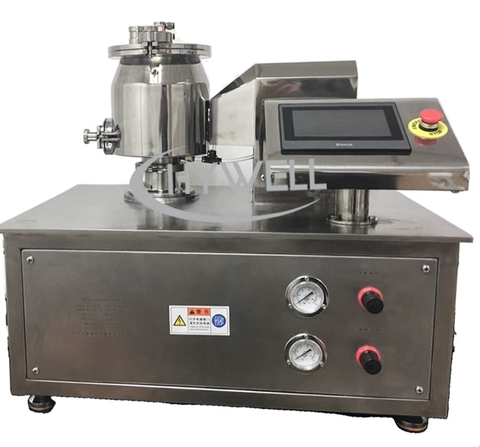
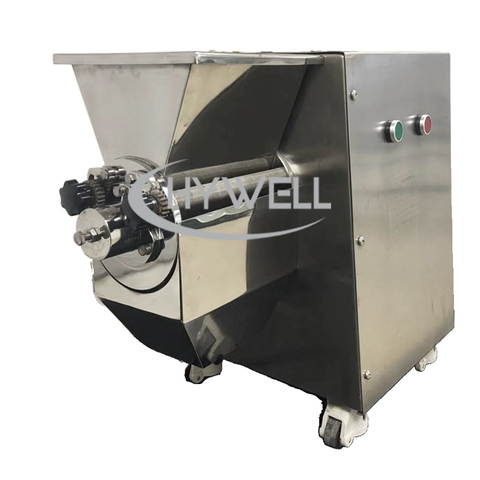
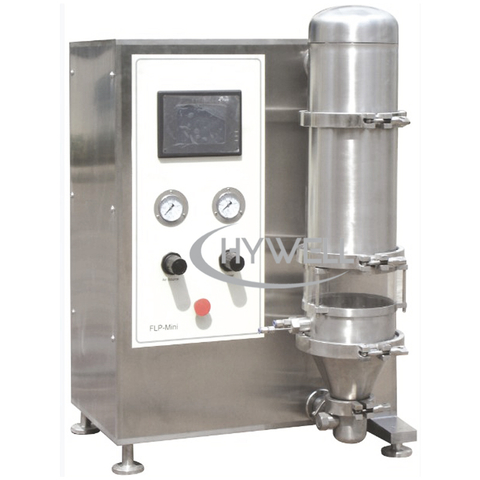
Types of Laboratory Granulators
Working Principle of Laboratory Granulators
All laboratory granulation equipment operates based on controlled wetting, mixing, and agglomeration. In wet laboratory granulation, powders are sprayed with a binder to form granules. In dry laboratory granulation, powders are compacted and milled into granules. A laboratory pelletizer ensures reproducibility, precise parameter control, and reliable data for scale-up.
Advantages of Laboratory Granulation Equipment
Laboratory granulators offer several advantages, including:
Improved powder flowability
Enhanced compressibility
Better solubility performance
Reduced dust generation
Minimized segregation
Improved batch-to-batch consistency
Stable and reproducible granule properties
Applications of Lab Granulators
Pharmaceutical Laboratories
Lab granulators are widely used for tablet and capsule formulation development, bioavailability studies, and scale-up trials.
Chemical R&D
Laboratory pelletizers support the development of detergents, catalysts, fertilizers, and specialty chemicals.
Food & Nutrition Labs
Laboratory granulation machines are applied to instant powders, seasoning blends, functional ingredients, and nutritional formulations.
Conclusion
A laboratory granulator is an essential tool in modern R&D and pilot-scale processing. By converting powders into uniform granules, lab granulation equipment improves handling, testing accuracy, and scalability. With benefits such as improved flowability, compressibility, and reproducibility, laboratory pelletizers are widely used in pharmaceutical, chemical, and food research applications.
FAQs
1. What is the difference between wet and dry laboratory granulation?
Wet granulation uses a binder solution, while dry granulation relies on compaction without liquid.
2. Why are granules preferred over powders in lab studies?
Granules offer better flow, uniformity, compressibility, and reduced dust.
3. What types of laboratory granulators are available?
High shear lab granulators, fluid bed lab granulators, extrusion–spheronization pelletizers, basket granulators, and oscillating granulators.
4. Are laboratory granulators customizable?
Yes, lab granulator machines can be customized in capacity, materials, and configuration to meet specific R&D needs.
 Русский
 English
 العربية
 Français
 Español
 Português
 Deutsch
 italiano
 日本語
日本語 한국어
한국어 Nederlands
 Tiếng Việt
 ไทย
ไทย Polski
 Türkçe
 ພາສາລາວ
 Bahasa Melayu
 Filipino
 Bahasa Indonesia
 magyar
 Română
 Čeština
 қазақ
қазақ Српски
 हिन्दी
 فارسی
فارسی Slovenčina
 Slovenščina
 Norsk
Norsk Svenska
 українська
 Ελληνικά
 Suomi
Suomi Հայերեն
 עברית
עברית Dansk
Dansk اردو
اردو বাংলা
বাংলা Hrvatski
 Afrikaans
 Gaeilge
 Eesti keel
 Māori
Māori नेपाली
 Oʻzbekcha
 latviešu
 Azərbaycan dili
 Беларуская мова
 Български
 ქართული
 Kurdî
Kurdî Кыргызча


 简体中文
简体中文
 简体中文
简体中文