IBC Bin Blender Production Line for Closed Powder Mixing
An IBC Bin Blender Production Line is an integrated powder handling and mixing system designed to improve powder transfer, blending, discharge, cleaning, and batch changeover.
Instead of transferring powder between multiple open containers, the IBC bin can be used as the material container throughout much of the process. Powder is loaded into the IBC bin, transported to the IBC bin blender, mixed according to the required recipe, and then discharged directly to a packing machine or downstream production equipment.
For pharmaceutical, nutraceutical, food, chemical, and other powder-processing applications, the system can be designed around closed powder handling, dust control, reduced material loss, and easy cleaning.
A typical IBC powder mixing production line consists of four main sections:
IBC Bin Powder Loading
IBC Bin Blending
IBC Bin Discharge to Packing
IBC Bin Cleaning and Drying
1. IBC Bin Powder Loading System
The first section of the production line is the powder loading system.
Different loading methods can be selected according to the material characteristics, production capacity, dust-control requirements, and especially the frequency of product changeover.
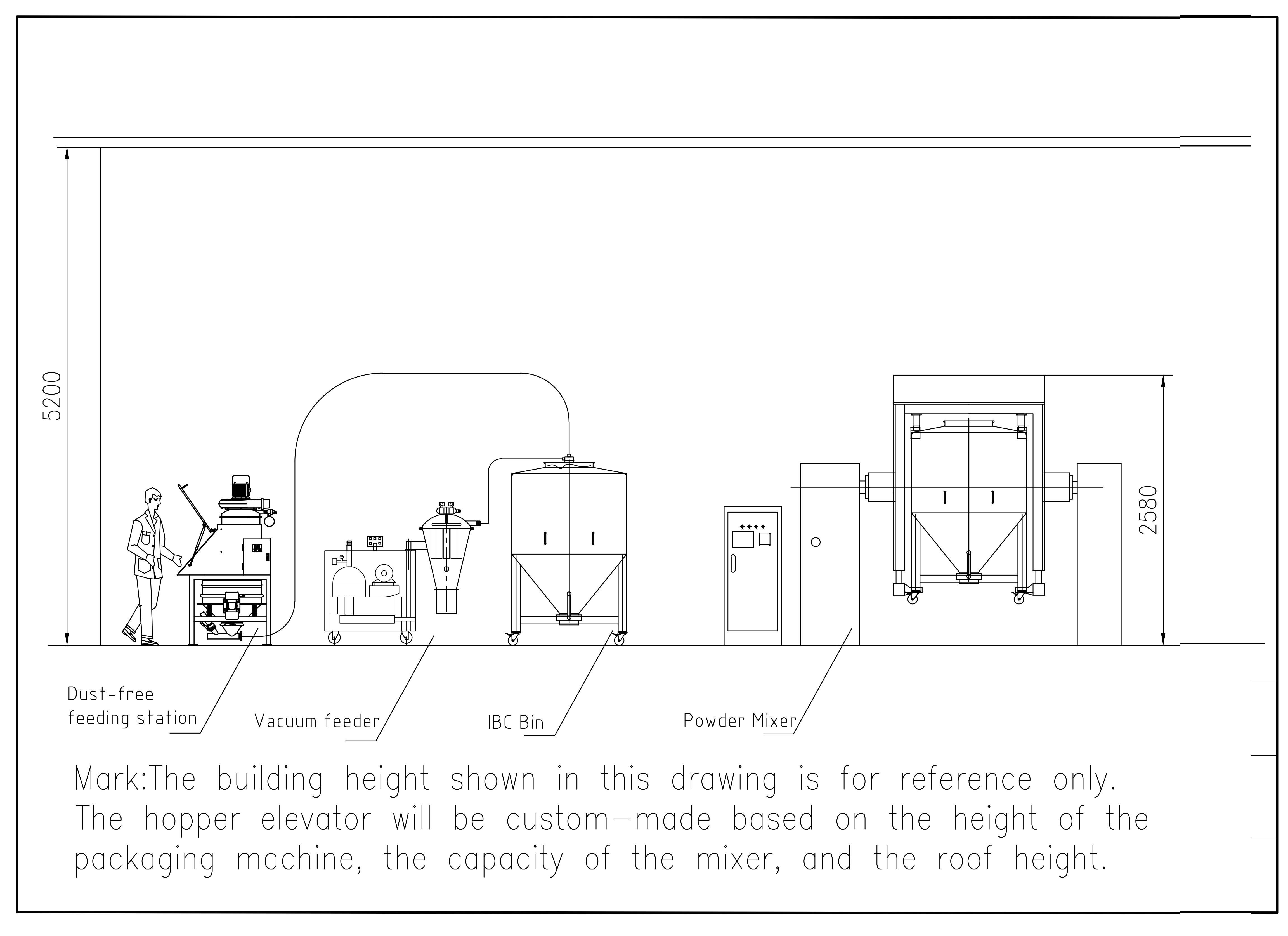
Vacuum Closed Powder Loading
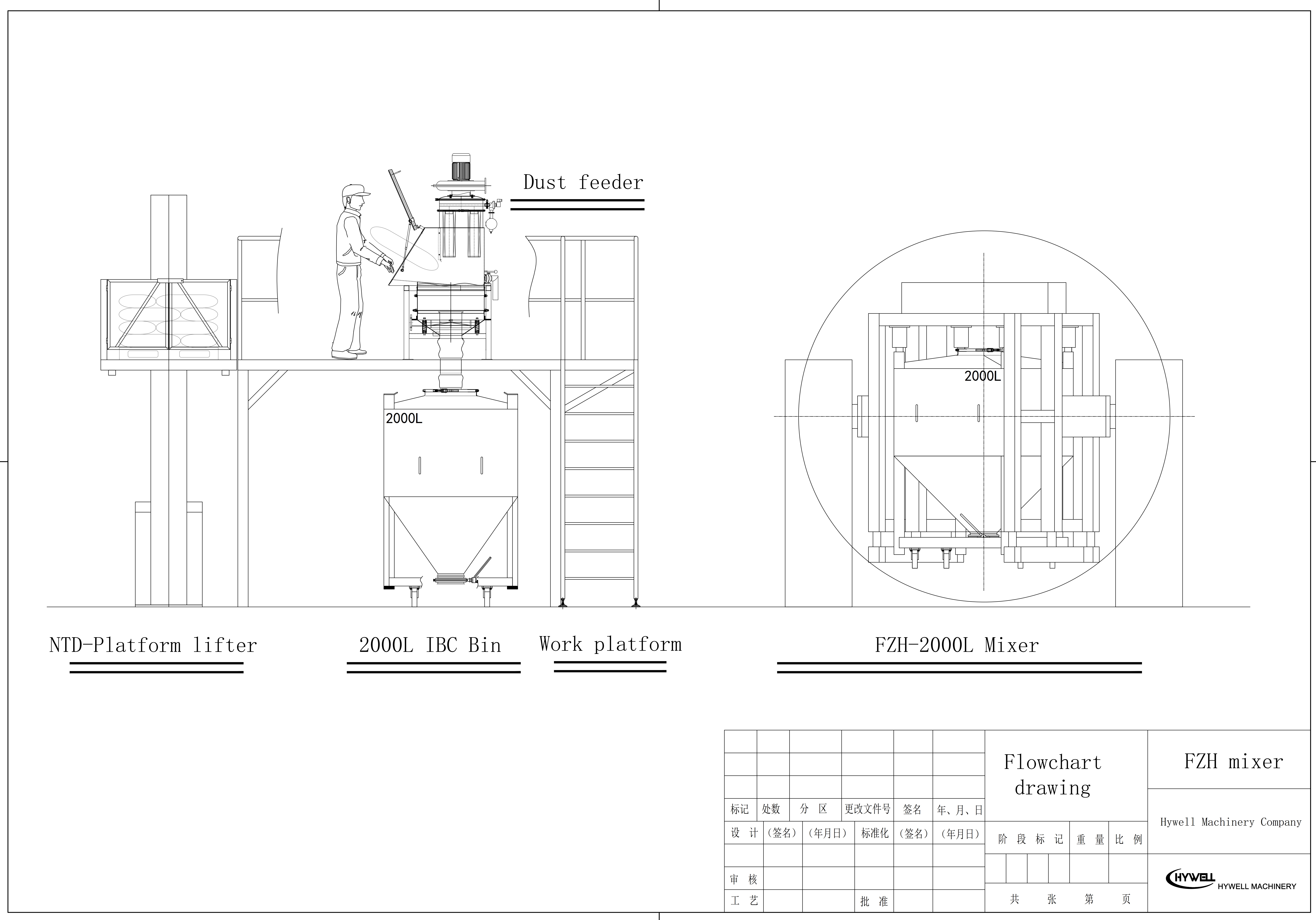
Platform Feeding to IBC Bin
Vacuum Closed Powder Loading
For applications requiring a more enclosed powder handling process, a vacuum powder transfer system can be used.
The powder is transferred from the feeding point to the IBC bin through a closed conveying system. This configuration can help reduce dust escaping into the working environment and minimize manual powder handling.
It is particularly suitable for:
The complete system can integrate a vacuum conveyor, dust-free feeding station, sieve, IBC bin and related transfer equipment.
Platform Feeding Directly into the IBC Bin
Another option is to install a feeding platform above the IBC bin. Operators can feed the powder directly into the IBC bin through the enclosed feeding station.
This solution has a relatively simple structure and can be suitable when the production process does not require frequent product changeover.
However, even with manual feeding, the overall system should still consider dust-free and enclosed powder handling rather than simply feeding powder into an open container.
Which Loading Method Is Better?
There is no single loading method that is suitable for every IBC mixing line.
The more important question is:
How frequently does the production line change products or formulations?
If different products are frequently processed on the same production line, cleaning and cross-contamination control become more important. A closed transfer system can help improve the overall hygiene and containment design.
If the same powder or formulation is produced continuously for a relatively long period, a simpler loading arrangement may be sufficient.
Therefore, the loading system should be selected based on the production process rather than simply the machine configuration.
2. IBC Bin Blender Mixing System
The second section is the core of the production line: the IBC Bin Blender.
After loading, the IBC bin is moved to the blender and connected to the mixing machine. The IBC bin itself acts as the mixing container, eliminating the need to transfer the powder into a separate fixed mixing vessel.
This provides several advantages:
Closed powder handling
Reduced manual material transfer
Less powder loss
Flexible batch production
Easy product changeover
Reduced cleaning requirements for the main mixer
Suitable for different batch sizes by changing IBC bins
The IBC bin blender can be designed for different bin capacities and powder bulk densities. Mixing parameters such as forward/reverse rotation, mixing time, and speed can be adjusted according to the material and formulation.
One Blender with Multiple IBC Bins
One important design option is whether to use:
One IBC blender + one IBC bin
or
One IBC blender + multiple IBC bins.
For production plants handling multiple batches, one main IBC blender can work with several IBC bins.
For example:
IBC Bin A → Loading → Mixing → Discharge
while another IBC Bin B can be prepared for the next batch.
This arrangement can improve equipment utilization and production flexibility.
Therefore, the number of IBC bins should be determined according to:
3. IBC Bin Discharge and Connection to the Packing Machine
After mixing, the IBC bin needs to be connected to the downstream packing machine.
The discharge configuration depends mainly on the layout of the factory and the type of packing machine.
There are generally two common solutions.
Solution A: IBC Bin Lifter for Discharge
An IBC bin lifting machine can lift the mixed IBC bin to the required height and connect the outlet of the bin with the packing machine.
This configuration provides flexibility when the packing machine inlet is relatively high.
The process can be:
IBC Bin Blender → Mixed IBC Bin → IBC Bin Lifter → Packing Machine
The lifting system can also be designed with a suitable discharge valve or closed connection to minimize powder exposure during discharge.
Solution B: Direct Discharge from a Platform
If the packing machine has a suitable feeding height, the IBC bin can be positioned on a platform above the packing machine.
The powder can then discharge directly from the IBC bin into the packing machine.
This configuration has a simpler material flow and can reduce the number of intermediate handling machines.
The selection between these two solutions should be based on the packing machine inlet height, factory layout, IBC bin dimensions, material flow and dust-control requirements.
4. IBC Bin Cleaning and Drying System
The fourth section is the IBC Bin Cleaning and Drying System.
This part becomes particularly important when the same production line is used for different formulations.
After one batch has been discharged, the IBC bin can be transferred to the cleaning machine.
The cleaning process may include:
Pre-cleaning → Hot Water Cleaning → Detergent/Alkali Cleaning → Purified Water Rinsing → Hot-Air Drying
The exact cleaning procedure depends on the customer's production requirements and cleaning validation strategy.
IBC Bin Cleaning
The IBC cleaning machine can use a lifting cleaning head and high-pressure cleaning system to clean the internal surfaces of the bin.
The cleaning system can be configured for different cleaning media, such as:
Hot water
Cleaning solution
Alkali solution
Purified water
The objective is to remove residual powder from the IBC bin before the next formulation is introduced.
IBC Bin Drying
After washing, the IBC bin must be completely dried before it is returned to production.
A hot-air drying system can be integrated into the IBC cleaning machine.
The drying temperature can be adjusted according to the IBC bin material and production requirements.
This allows the cleaned IBC bin to be quickly returned to the powder loading process.
Why IBC Bin Mixing Is Suitable for Multi-Product Production
One of the key advantages of an IBC-based powder mixing system is the flexibility of the production process.
The IBC bin can function as:
Loading Container → Transfer Container → Mixing Container → Discharge Container
This reduces the number of times the powder needs to be transferred between different vessels.
For manufacturers producing multiple formulations, the IBC system can also simplify batch changeover and cleaning management.
The actual configuration should therefore be determined according to how frequently the production line changes products.
For a production line with frequent formulation changes, more attention should be given to:
For a production line mainly producing one formulation, a simpler configuration may be more economical.
Complete IBC Powder Mixing Process
A typical complete IBC powder mixing line can be arranged as follows:
Powder Feeding → Closed Powder Transfer → IBC Bin → IBC Bin Blender → Mixed IBC Bin → Discharge System → Packing Machine
After production:
Empty IBC Bin → IBC Cleaning → Rinsing → Hot-Air Drying → Clean IBC Bin → Next Batch
This creates a complete production workflow from powder loading to mixing, packing, cleaning and preparation for the next batch.
Customized IBC Bin Blender Production Line
An IBC powder mixing line should not be designed simply by selecting an IBC blender and several auxiliary machines.
The complete system should be designed according to the customer's actual production process.
Important parameters include:
Powder characteristics
Bulk density
Batch size
Required mixing uniformity
Number of formulations
Product changeover frequency
Required cleaning procedure
Packing machine type
Packing machine inlet height
Factory layout
Dust-control requirements
Production capacity
Based on these parameters, the IBC loading, blending, discharge, cleaning and drying systems can be integrated into one complete automatic powder mixing production line.
Conclusion
A complete IBC Bin Blender Production Line can be divided into four major sections:
1. Closed IBC Bin Powder Loading
2. IBC Bin Blending
3. IBC Bin Discharge and Packing Connection
4. IBC Bin Cleaning and Drying
The most important point is that there is no universal configuration for every factory.
The powder loading method should mainly consider dust control and product changeover frequency. The IBC blending section is relatively standardized, while the number of IBC bins can be increased according to production requirements. The discharge system should match the packing machine and factory layout. The IBC cleaning and drying system becomes especially important when different formulations are frequently produced on the same equipment.
By combining these four sections, an IBC system can provide a flexible solution for closed powder handling, batch powder mixing, efficient material transfer, product changeover, and IBC container cleaning.

 Русский
 English
 العربية
 Français
 Español
 Português
 Deutsch
 italiano
 日本語
日本語 한국어
한국어 Nederlands
 Tiếng Việt
 ไทย
ไทย Polski
 Türkçe
 ພາສາລາວ
 Bahasa Melayu
 Filipino
 Bahasa Indonesia
 magyar
 Română
 Čeština
 қазақ
қазақ Српски
 हिन्दी
 فارسی
فارسی Slovenčina
 Slovenščina
 Norsk
Norsk Svenska
 українська
 Ελληνικά
 Suomi
Suomi Հայերեն
 עברית
עברית Dansk
Dansk اردو
اردو বাংলা
বাংলা Hrvatski
 Afrikaans
 Gaeilge
 Eesti keel
 Māori
Māori नेपाली
 Oʻzbekcha
 latviešu
 Azərbaycan dili
 Беларуская мова
 Български
 ქართული
 Kurdî
Kurdî Кыргызча


 简体中文
简体中文