Views: 0 Author: Site Editor Publish Time: 2026-05-31 Origin: Site
In powder processing industries such as pharmaceuticals, food, nutraceuticals, chemicals, and battery materials, achieving uniform powder mixing becomes extremely challenging when one ingredient accounts for only 0.01% of the total formulation while the main material represents more than 90%.
For example, in a 1,000 kg batch, a 0.01% ingredient equals only 0.1 kg. The mixing ratio between the minor ingredient and the total batch becomes 1:10,000.
At this ratio, simply adding the trace ingredient directly into the main powder and running a mixer for a longer time rarely produces satisfactory results. In fact, increasing mixing time alone often cannot solve the problem and may even increase the risk of segregation.
The key to solving ultra-low dosage powder mixing is not selecting a larger powder mixer—it is selecting the correct mixing strategy.
Many manufacturers assume that a high-performance powder mixer can solve any mixing challenge. However, when the ratio reaches 1:10,000, the issue is no longer mixer capacity but particle distribution probability.
Common problems include:
Poor content uniformity
Concentration hotspots
Segregation during discharge
Batch-to-batch inconsistency
Product quality deviations
Failed uniformity testing
Even if a mixer achieves excellent macro mixing, the trace ingredient may still not be evenly distributed throughout the entire batch.
This is especially critical in pharmaceutical products, food additives, nutritional supplements, flavors, pigments, catalysts, and specialty chemical formulations.
The industry-recognized solution for low-dosage powder blending is geometric dilution, also known as step-by-step premixing.
Instead of attempting to distribute 0.1 kg directly into 1,000 kg of powder, the minor ingredient is gradually diluted through intermediate mixing stages.
The principle is simple:
Mix small quantities first, then progressively increase the batch size.
This approach dramatically improves particle distribution and allows the trace ingredient to be dispersed uniformly before entering the final blend.
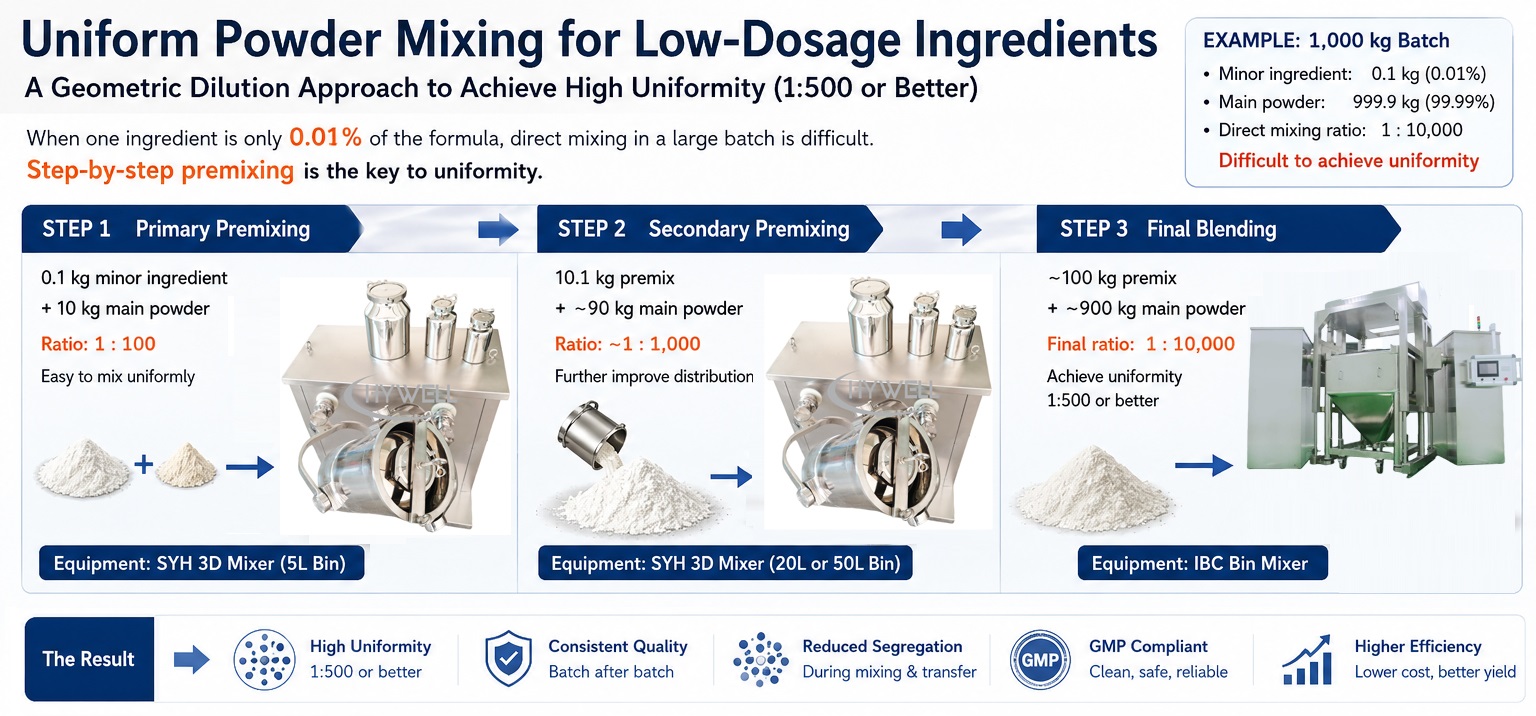
Consider the following formulation:
Total batch size: 1,000 kg
Minor ingredient: 0.1 kg
Main powder: 999.9 kg
Direct addition creates a ratio of: 1: 10,000
Achieving true uniformity at this ratio is extremely difficult.
A more effective process would be:
Mix:
0.1 kg minor ingredient
10 kg main powder
The ratio becomes: 1: 100
This ratio is well within the range where most powder mixers can achieve excellent homogeneity.
At this stage, the low-dosage ingredient becomes uniformly dispersed throughout the carrier powder.
The SYH 3D Mixer is especially suitable for low-dosage premixing applications because of its multidirectional movement.
Using interchangeable bins such as:
5L bin
20L bin
50L bin
The first premix (10.1 kg) is then blended with additional main powder.
For example:
10.1 kg first premix
Approximately 90 kg of main powder
The material is now distributed throughout roughly 100 kg of powder.
The concentration difference between particles is reduced significantly compared with direct blending.
The premixed material is then transferred into the full production batch.
Since the trace ingredient has already been uniformly distributed during the premixing stages, the final mixing step becomes much easier and more reliable.
This method can effectively achieve mixing uniformity within 1:500 or better, depending on the material characteristics and process validation results.
IBC Bin Mixer is a flexible powder blending system with one main drive unit compatible with different volume IBC bins, enabling efficient mixing of various batch sizes with uniform results.
Hywell Machinery has a complete powder mixing line to process the close mixing and transfer.
Many production teams attempt to solve uniformity problems by increasing mixing time.
Unfortunately, this often produces little improvement because:
Trace particles remain clustered together
Particle size differences cause segregation
Density differences promote separation
Material flow patterns become repetitive
Premixing changes the distribution mechanism itself.
Instead of relying on random particle movement inside a large batch, geometric dilution ensures that the active ingredient is already dispersed before entering the final blend.
This significantly increases the probability of uniform distribution throughout the entire production batch.
Even with a proper premixing strategy, several additional factors affect final results.
Large differences in particle size increase segregation risk.
Whenever possible, particle sizes should be matched before blending.
Materials with significantly different densities tend to separate during transport and discharge.
Density matching or granulation may be required.
Free-flowing powders often segregate more easily than cohesive powders.
Understanding material characteristics is essential when designing a mixing process.
A perfectly mixed batch can lose uniformity during transfer.
Excessive dropping heights, manual handling, and repeated conveying should be minimized.
When working with low-dosage ingredients, accurate weighing becomes critical.
Even small weighing errors can exceed the acceptable content variation range.
When handling ingredients at 0.01% levels, material loss becomes a serious concern.
For a 0.1 kg additive, losing only a few grams during feeding can significantly affect the final formulation.
Therefore, many manufacturers integrate:
Vacuum conveying systems
Dust-free feeding stations
Closed powder transfer systems
Contained material handling processes
These solutions help maintain formulation accuracy while improving workplace cleanliness and operator safety.
For ultra-low dosage formulations, a typical process may follow this sequence:
Accurate ingredient weighing
Small-scale premixing
Secondary premixing
Final batch blending
Controlled material transfer
Packaging or downstream processing
The focus should always be on progressive dilution, not simply extending mixing time.
When one ingredient represents only 0.01% of a formulation, direct mixing into a large batch often cannot deliver the required powder mixing uniformity.
The most reliable solution is a geometric dilution strategy, where the trace ingredient is first mixed with a small amount of carrier powder and then progressively diluted through multiple blending stages before entering the final batch.
By combining proper premixing, controlled material handling, dust-free transfer, and validated mixing procedures, manufacturers can achieve highly consistent powder blends even when the mixing ratio reaches 1:10,000.
For pharmaceutical, food, nutraceutical, chemical, and battery material production, this approach remains one of the most effective methods for achieving stable, repeatable, and high-quality powder mixing results.
 简体中文
简体中文
 简体中文
简体中文