1. Background of Wet Granulation Technology
Wet granulation is one of the most mature and widely used technologies in powder processing. It has long played a key role in industries such as pharmaceuticals, food, chemicals, new materials, traditional Chinese medicine granules, and functional additives. By adding a suitable binder to powders and forming granules under mechanical and airflow action, wet granulation effectively solves common problems of powders, such as poor flowability, dust generation, segregation, and unstable dosing.
Among various wet granulation technologies, the vertical fluid bed granulator (FL type) has become the most commonly used solution due to its mature process, extensive application experience, and high market acceptance. This equipment integrates mixing, granulation, and drying in a single unit and is highly flexible, making it suitable for multi-product and small- to medium-scale production. Therefore, it has been widely adopted in the pharmaceutical and fine chemical industries.
However, with the increasing demand for higher capacity, continuous production, enclosed operation, dust control, and automation, the inherent limitations of traditional vertical fluid bed granulators have gradually become apparent.
2. Limitations of Conventional Vertical Fluid Bed Granulators
The vertical fluid bed granulator is essentially a batch-type system, and this production mode inherently limits its scalability and output. The main drawbacks include:
2.1 Batch operation with limited capacity
Each batch must go through feeding, mixing, spraying, granulation, drying, and discharging. Frequent loading and unloading interrupt effective operating time, resulting in limited throughput per hour.
2.2 Restricted scale-up
As vessel volume increases, it becomes increasingly difficult to maintain uniform fluidization, airflow distribution, and spray homogeneity. Very large batch fluid bed granulators often suffer from uneven granulation, agglomeration, and reduced drying efficiency.
2.3 Poor continuity of the process
Connection with downstream processes such as sieving, milling, and packaging often relies on manual or semi-automatic handling, making it difficult to form a truly continuous production line.
2.4 Limited enclosure
Although the granulator itself can be enclosed, dust leakage may still occur during discharge, sieving, and fines return, posing challenges for environmental protection and ATEX compliance.
Under these conditions, continuous wet granulation technology has become an inevitable development direction for the industry.
3. Technical Concept of Hywell Continuous Static Fluid Bed Granulator
To overcome the capacity and continuity limitations of traditional batch fluid bed granulators, Hywell has developed a continuous fluid bed granulation solution — the Continuous Static Fluid Bed Granulator.
This system is still based on the proven principle of fluid bed granulation, but with systematic innovations in structural design, material flow organization, and system integration. It enables:
Continuous feeding
Continuous granulation
Continuous drying
Continuous sieving and material recycling
Fully enclosed operation
Thus, it fundamentally eliminates the production bottleneck of batch granulation.
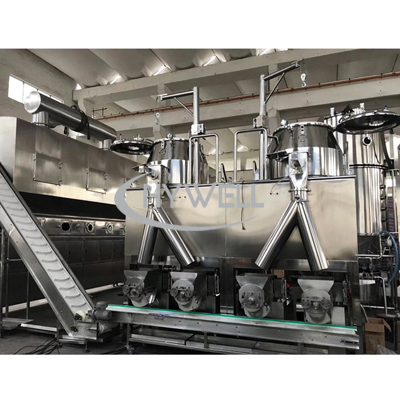
Continuous Static Fluid Bed Granulator
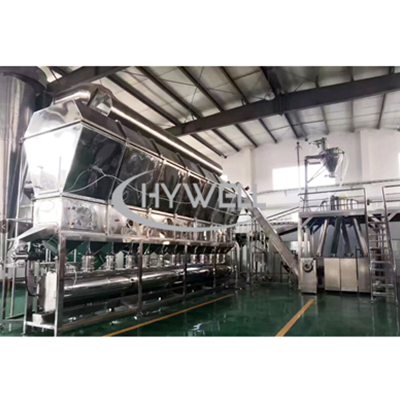
Continuous Fluidized Bed Granulator
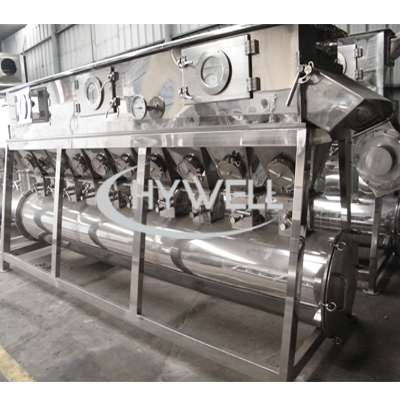
Static Fluidized Bed Granulator
4. Working Principle of the Continuous Static Fluid Bed Granulator
The Hywell continuous static fluid bed granulator adopts a static fluidized bed structure without high-speed rotating mechanical components. A precisely designed hot air distribution system ensures stable and uniform fluidization of the material inside the granulation chamber.
The working process is as follows:
4.1 Continuous feeding and fluidization
Powder materials are continuously fed into the lower section of the granulation chamber via a metering device. Under the action of hot air, the powder rapidly forms a stable fluidized state, providing an ideal foundation for granulation.
4.2 Binder spraying via multiple nozzles
Multiple spray nozzles are arranged at appropriate positions in the chamber to atomize and spray the binder into the fluidized powder. The binder causes fine particles to gradually agglomerate and form granules.
4.3 Simultaneous drying during granulation
While maintaining fluidization, the hot air continuously evaporates moisture from the material. Granule formation and drying occur simultaneously, preventing overwetting and bed collapse.
4.4 Continuous discharge
The granulated and dried material is continuously discharged through a rotary valve, ensuring system sealing and stable material transfer.
5. Downstream Processing and Closed-Loop System Design
The advantages of continuous granulation are not only reflected in the granulator itself but also in the integrated design of the entire production line.
5.1 Online sieving
The discharged granules directly enter a square vibrating sieve for size classification, ensuring stable and controlled particle size distribution.
5.2 Oversize granule milling and recycling
Oversized particles are automatically conveyed to a dry granulator or mill for size reduction and then returned to the sieving system, minimizing material loss.
5.3 Fines recycling for secondary granulation
Fine powder is conveyed in a fully enclosed manner by a vacuum conveying system back to the granulator inlet for secondary granulation, significantly improving product yield.
5.4 Direct transfer of qualified granules
Granules meeting the size specification are directly conveyed by vacuum to a packaging machine or blender, enabling a truly continuous process.
The entire line operates as a fully enclosed closed-loop system, with no open handling points and no dust emission.
6. Key Advantages of the Continuous Fluid Bed Granulation Line
Compared with conventional FL batch fluid bed granulators, the Hywell continuous static fluid bed granulation system offers significant advantages:
6.1 High capacity and easy scale-up
Capacity can be increased by extending the bed length and increasing air volume and spray nozzles, without batch size limitations.
6.2 True continuous operation
Suitable for 24/7 industrial production, especially for medium- to large-scale manufacturing.
6.3 High automation level
Easy integration with PLC or DCS systems, significantly reducing manual intervention.
6.4 Excellent product consistency
Stable continuous operating conditions ensure uniform particle size distribution and moisture content.
6.5 Better compliance with environmental and ATEX requirements
Effectively reduces dust explosion risks and improves occupational safety.
7. Application Prospects
Hywell continuous static fluid bed granulation lines are widely applicable to:
Pharmaceutical granules and TCM granules
Instant food and seasoning granules
Chemical additives and detergent granules
Functional granules for new materials
As industries continue to move toward continuous, automated, and fully enclosed production, continuous fluid bed granulation technology is expected to gradually replace traditional batch granulation systems and become the mainstream solution for wet granulation in the future.

 Русский
 English
 العربية
 Français
 Español
 Português
 Deutsch
 italiano
 日本語
日本語 한국어
한국어 Nederlands
 Tiếng Việt
 ไทย
ไทย Polski
 Türkçe
 ພາສາລາວ
 Bahasa Melayu
 Filipino
 Bahasa Indonesia
 magyar
 Română
 Čeština
 қазақ
қазақ Српски
 हिन्दी
 فارسی
فارسی Slovenčina
 Slovenščina
 Norsk
Norsk Svenska
 українська
 Ελληνικά
 Suomi
Suomi Հայերեն
 עברית
עברית Dansk
Dansk اردو
اردو বাংলা
বাংলা Hrvatski
 Afrikaans
 Gaeilge
 Eesti keel
 Māori
Māori नेपाली
 Oʻzbekcha
 latviešu
 Azərbaycan dili
 Беларуская мова
 Български
 ქართული
 Kurdî
Kurdî Кыргызча


 简体中文
简体中文