1. Key Factors Affecting Powder Mixing Uniformity
Achieving high powder mixing uniformity requires careful control of several critical factors, including:
Mixer type
Powder ratio
Particle size distribution
Material density
Mixing time
Material transfer process
In modern powder processing industries, the bin blender has become one of the preferred solutions for high-uniformity and GMP applications because it significantly reduces segregation during material handling and transfer.
For difficult powder systems, granulation technology can further improve product consistency, reduce dust generation, and enhance production stability.
Selecting the correct powder mixer and powder processing system is essential for improving product quality, reducing segregation, and increasing manufacturing efficiency.
Powder mixing uniformity is especially important in industries such as food processing, pharmaceuticals, chemicals, nutraceuticals, and battery materials. Poor powder blending may lead to ingredient separation, unstable product quality, inaccurate dosing, and production losses.
This article explains the key factors affecting powder mixing uniformity and how to prevent powder segregation during industrial powder blending.
2. Choosing the Right Powder Mixer
Selecting the correct powder mixer is the foundation of achieving uniform blending. Different mixers are suitable for different powder characteristics, batch sizes, and production requirements.
Common industrial powder mixers include:
V Blender — suitable for free-flowing powders and gentle mixing
Ribbon Blender — widely used for large-capacity powder blending
IBC Bin Mixer — ideal for GMP production and reducing segregation during transfer
3D Powder Mixer — suitable for fragile materials and large-volume mixing
The correct mixer should be selected based on particle size, bulk density, flowability, ingredient ratio, and product sensitivity. Hywell machinery have the completed powder mixing line to process the close mixing and transfer.
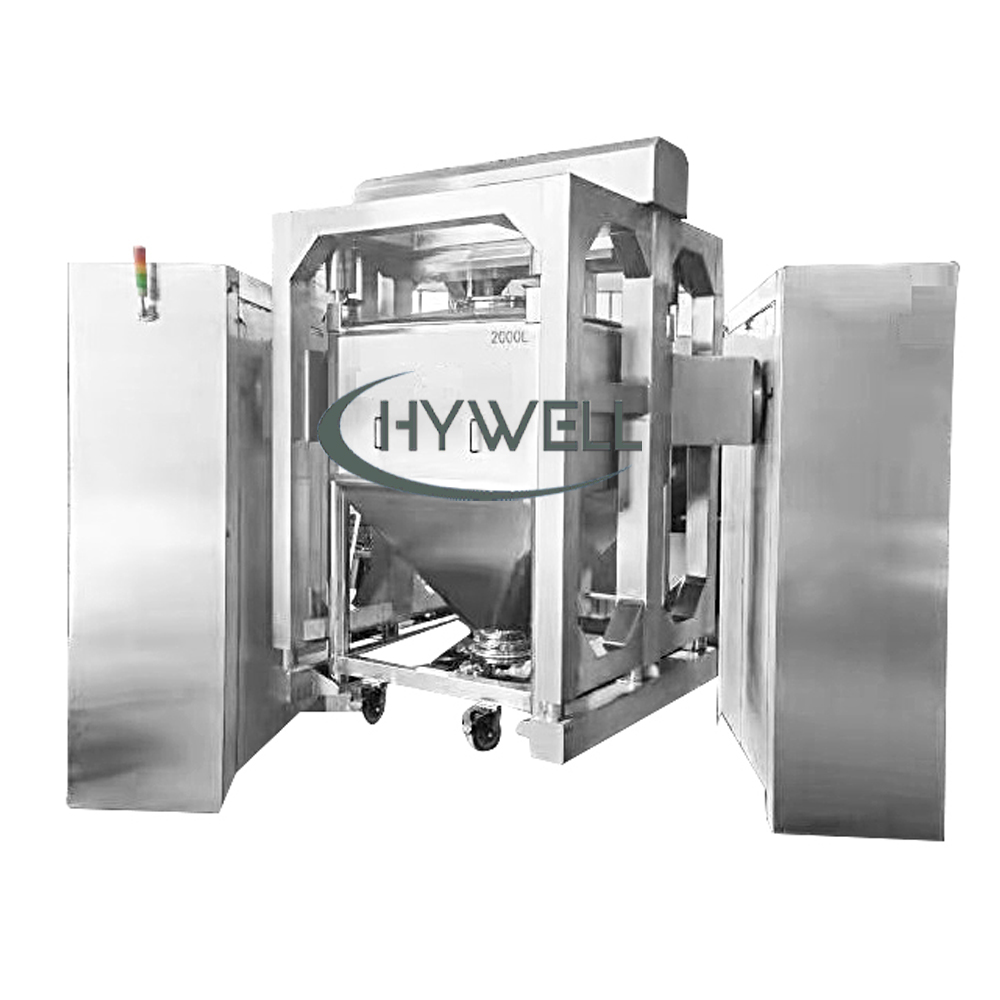
IBC Bin Blender
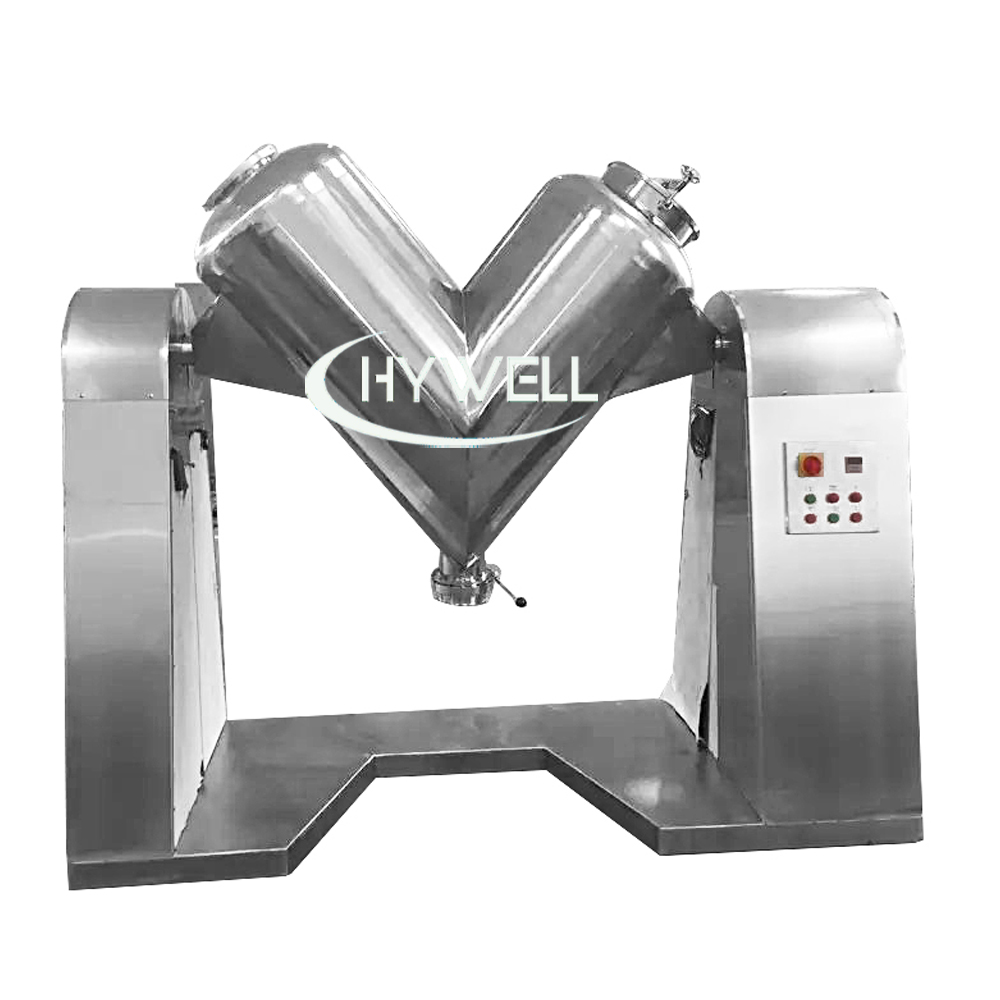
V Type Mixer
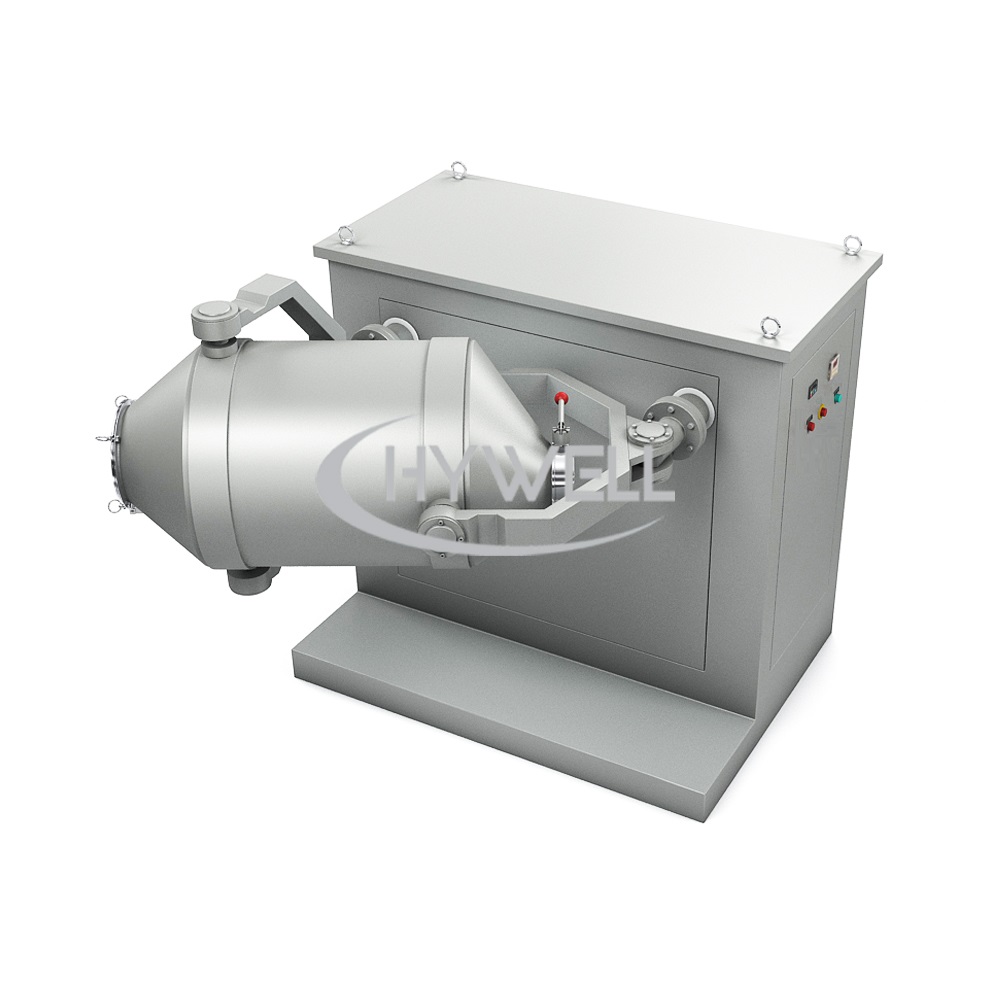
3D Powder Blender
3. Powder Mixing Ratio
The ratio between different powder ingredients strongly influences blending uniformity.
Can Powders with a 1000:1 Ratio Be Mixed Directly?
Usually, direct mixing is not recommended.
Examples include:
Direct blending may cause:
Uneven distribution
Local concentration
Product inconsistency
Geometric Dilution Method for Low-Dosage Ingredients
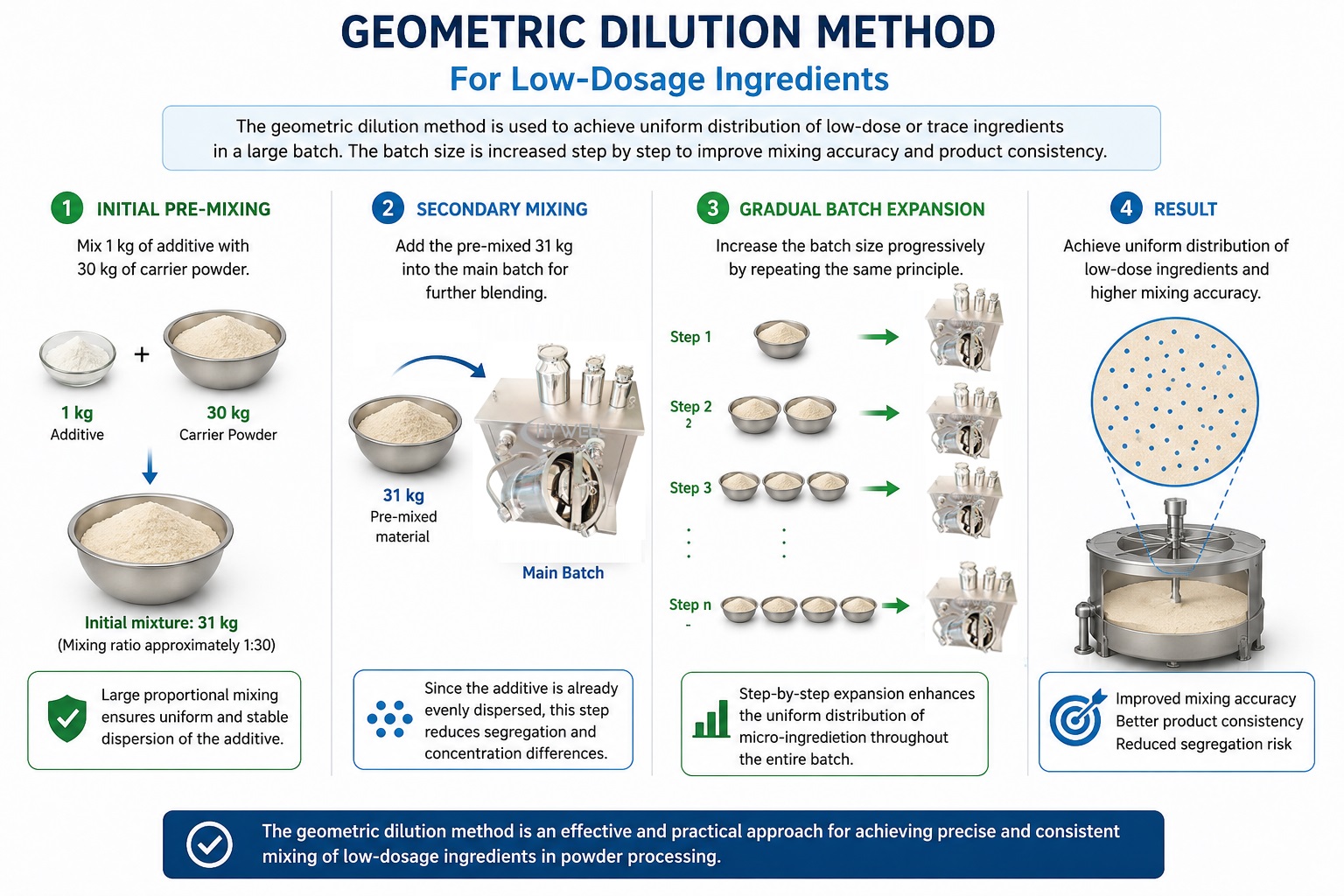
For low-dosage or trace ingredients, the geometric dilution method is widely used to improve mixing uniformity and ensure accurate distribution throughout the batch. This method is especially important when a small amount of additive needs to be evenly dispersed into a much larger quantity of powder.
The process is carried out step by step:
1. Initial Pre-Mixing
First, 1 kg of the additive (the lowest-dosage ingredient) is mixed with 30 kg of carrier powder.
This creates a mixing ratio of approximately 1:30, which helps achieve a more uniform and stable distribution of the additive.
2. Secondary Mixing
After the initial 31 kg mixture becomes homogeneous, the pre-mixed material is added into a larger batch for further blending.
Because the additive has already been evenly dispersed during the first stage, segregation and concentration differences can be significantly reduced.
3. Gradual Batch Expansion
The batch size is then increased progressively by repeating the same principle.
This gradual expansion method allows micro-ingredients to distribute more evenly throughout the entire production batch.
By using geometric dilution, manufacturers can greatly improve the mixing accuracy of low-dose components, reduce segregation risks, and achieve better product consistency in powder processing applications.
4. Particle Size and Powder Mixing Uniformity
Particle size is one of the most critical factors affecting powder segregation.
Why Particle Size Matters
When particle sizes differ significantly:
Fine particles move downward
Large particles rise upward
Segregation occurs during vibration or transportation
This phenomenon is often called the “Brazil Nut Effect.”
Recommended Particle Size Ratio
For stable blending-Ideal condition
Particle size ratio < 3:1
Example:
This range usually produces stable and uniform mixing.
High segregation risk
Particle size ratio > 5:1
Example:
This commonly leads to powder separation after mixing.
5. What Particle Size Range Can Be Mixed Uniformly?
Uniform powder mixing depends on both average particle size and particle size distribution.
Recommended Guidelines
Material Type | Recommended Particle Size Difference |
Fine powders | Less than 3× |
Granules | Less than 2× |
High-density powders | Similar particle sizes |
Fragile materials | Narrow size distribution |
If particle size differences are too large, granulation is often a better solution than direct powder mixing. |
6. Mixing Time and Segregation Prevention
Longer mixing time does not always improve mixing uniformity.
In many cases, overmixing increases segregation risk.
Three Stages of Powder Mixing
Stage 1 – Initial Dispersion
Ingredients begin distributing evenly.
Stage 2 – Optimal Uniformity
Maximum homogeneity is achieved.
Stage 3 – Re-segregation
Overmixing may cause:
Heavy particles to settle
Fine powders to separate
Reduced uniformity
7. Typical Powder Mixing Time
Mixer Type | Typical Mixing Time |
V Blender | 10–20 min |
Ribbon Blender | 5–15 min |
IBC Bin Mixer | 8–20 min |
3D powder mixer | 8–15 min |
The actual powder mixing time depends on several factors, including powder characteristics, batch size, bulk density, particle size distribution, and the required mixing uniformity. In industrial powder blending and powder processing applications, the optimal mixing time should always be verified through practical testing and sampling analysis to ensure consistent product quality and prevent segregation or over-mixing.
8. How to Prevent Powder Segregation
1. Control Particle Size Distribution
Closer particle sizes improve mixing stability.
2. Reduce Density Differences
Large density differences increase separation risk.
3. Minimize Material Transfer
Repeated conveying and falling increase segregation.
IBC bin mixers are especially effective because they reduce intermediate transfer steps.
4. Use Granulation Technology
Granules are much more stable than fine powders.
Many manufacturers convert powder into granules to:
Common granulation technologies include:
 Русский
 English
 العربية
 Français
 Español
 Português
 Deutsch
 italiano
 日本語
日本語 한국어
한국어 Nederlands
 Tiếng Việt
 ไทย
ไทย Polski
 Türkçe
 ພາສາລາວ
 Bahasa Melayu
 Filipino
 Bahasa Indonesia
 magyar
 Română
 Čeština
 қазақ
қазақ Српски
 हिन्दी
 فارسی
فارسی Slovenčina
 Slovenščina
 Norsk
Norsk Svenska
 українська
 Ελληνικά
 Suomi
Suomi Հայերեն
 עברית
עברית Dansk
Dansk اردو
اردو বাংলা
বাংলা Hrvatski
 Afrikaans
 Gaeilge
 Eesti keel
 Māori
Māori नेपाली
 Oʻzbekcha
 latviešu
 Azərbaycan dili
 Беларуская мова
 Български
 ქართული
 Kurdî
Kurdî Кыргызча


 简体中文
简体中文
 简体中文
简体中文