The Hywell V Powder Mixer, also known as a V blender or V-shell blender, mixes free-flowing dry powders and granules in batches. The rotating V-shaped vessel repeatedly splits and recombines the material for gentle blending. Listed models range from 20 to 3,000 L in nominal vessel volume. Configurations up to 5,000 L are available on request.
How Does a V Powder Mixer Work?
The Hywell V Powder Mixer, also known as a V-shell blender, blends free-flowing dry powders and granules by repeatedly splitting and recombining the material inside a rotating V-shaped vessel.
The vessel consists of two inclined cylindrical sections welded together at an angle. In the belt-driven configuration, the motor drives a reduction gearbox through a belt, and the gearbox turns the vessel through a coupling. As the vessel rotates, gravity causes the material to tumble across each section and flow along its length. The batch divides between the two branches and comes back together at the junction, redistributing the ingredients with each rotation.
The rotating vessel provides gentle blending for free-flowing materials. An optional intensifier bar can help break up soft lumps. Blend uniformity depends on the formulation, fill level, rotation speed, and mixing time. A trial with representative material can help establish the operating settings for a specific blend.
At the end of the cycle, the vessel stops in the discharge position and the blend flows by gravity through the butterfly valve at the base of the V. Hywell offers manual and pneumatic valve options. Safety guarding with an interlock can also be specified for the selected configuration.
For formulation development and small-batch trials, see Hywell’s Laboratory V Mixers.
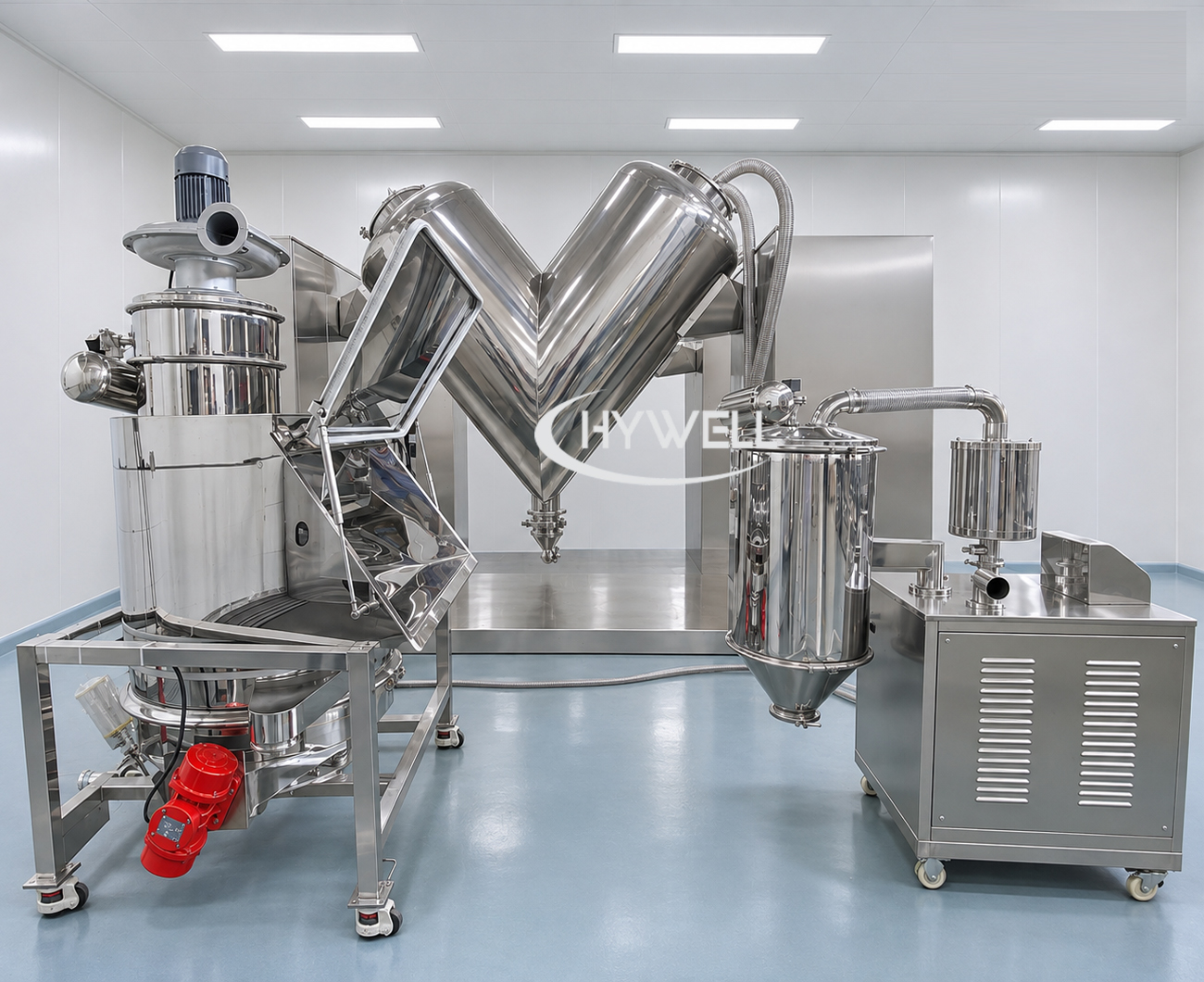
V Type Blender
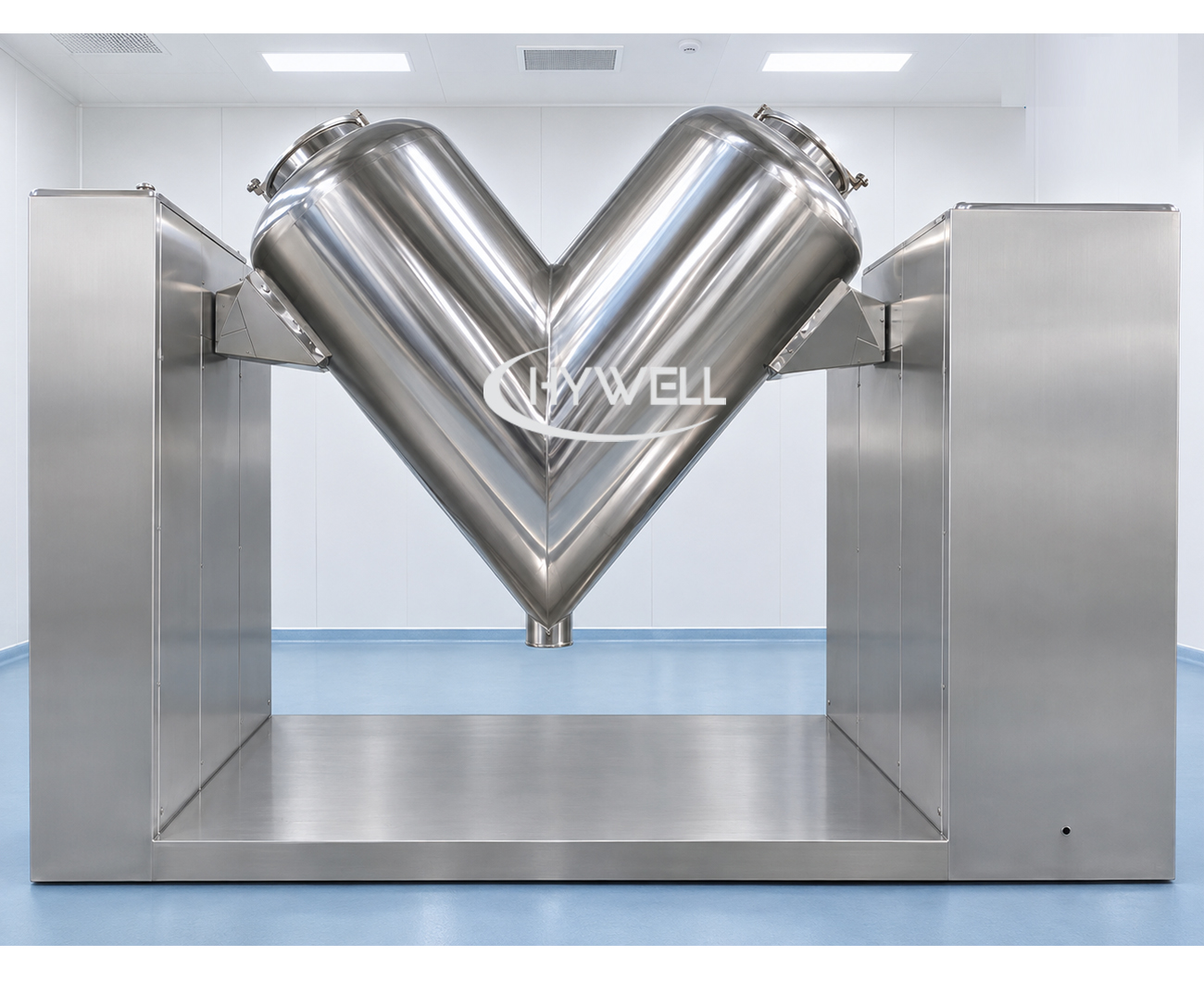
V Type Mixer
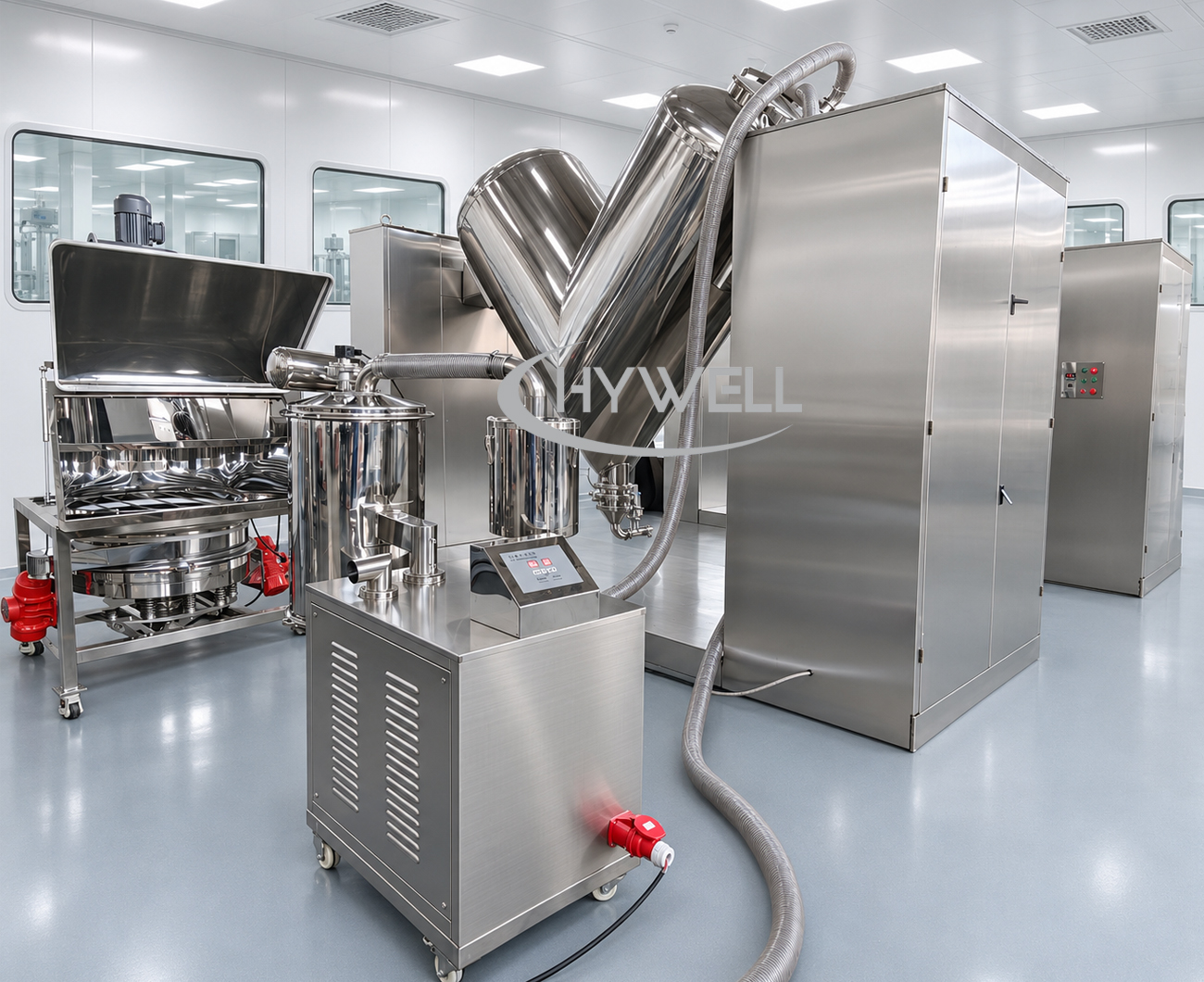
V Shell Mixer
V Powder Mixer Specifications
Nominal vessel volume is the total internal volume. The working volumes below are the listed reference volumes for blending. Confirm the usable fill range and rated product load for the material and configuration being quoted.
Model | Nominal volume (L) | Working volume (L) | Max. load (kg) | Mixing speed (rpm) | Power (kW) | Dimensions (mm) | Machine weight (kg) |
V-20 | 20 | 10 | 5 | 10–25 | 0.55 | 1,000 × 500 × 800 | 150 |
V-50 | 50 | 25 | 12.5 | 10–25 | 0.75 | 1,200 × 600 × 1,000 | 180 |
V-100 | 100 | 50 | 25 | 10–20 | 1.1 | 1,500 × 900 × 1,500 | 220 |
V-300 | 300 | 150 | 75 | 8–15 | 1.5 | 2,200 × 900 × 1,950 | 450 |
V-500 | 500 | 250 | 125 | 8–15 | 1.5 | 2,480 × 950 × 1,510 | 650 |
V-1000 | 1,000 | 500 | 250 | 8–12 | 3.0 | 2,980 × 1,000 × 2,420 | 1,300 |
V-1500 | 1,500 | 750 | 325 | 8–10 | 4.0 | 3,790 × 1,400 × 3,060 | 1,500 |
V-2000 | 2,000 | 1000 | 500 | 8–10 | 5.5 | 3,900 × 1,450 × 3,200 | 1,800 |
V-2500 | 2,500 | 1,250 | 625 | 4–8 | 7.5 | 4,200 × 1,550 × 3,500 | 2,000 |
V-3000 | 3,000 | 1,500 | 750 | 4–6 | 7.5 | 4,590 × 1,600 × 3,760 | 2,300 |
The listed working volumes are 50% of nominal volume. Overall dimensions and machine weights are for reference. Use the approved layout drawing to confirm clearance for the rotating vessel, guarding, charging and discharge.
How to Size a V Blender
Divide target batch weight by loose bulk density to estimate the volume the material occupies. Then check the selected model’s working volume and maximum product load.
For example, 200 kg of powder at 0.50 kg/L occupies 400 L. The V-800 lists a 400 L working volume and a 200 kg maximum product load, making it a candidate. At 1.00 kg/L the same batch occupies 200 L, but the V-400, with a 200 L working volume, is listed for a maximum load of 100 kg. Ask Hywell to evaluate a configuration rated for the heavier batch.
Sealed Feeding and Discharging for V-type mixer
The dust-free feeding system with vacuum conveying ensures fully enclosed loading into the V-type mixer. Bagged materials are introduced without any dust emission, maintaining a clean working environment. During discharge, the mixer outlet is directly connected to the vacuum conveyor. By simply opening the discharge valve, materials are efficiently transferred under negative pressure and delivered straight into the storage silo, achieving a completely sealed, hygienic, and safe material handling process.
Videos and Related Equipment
· V Powder Mixer operating video
· Laboratory V mixers
· Bag dump station and vacuum conveying system
Components of a V Powder Mixer
1.Mixing Chamber
The mixing chamber is the main component of a V-type powder mixer. It is a V-shaped container that is designed to hold the powder or granules that need to be mixed. The shape of the mixing chamber ensures that the powder or granules are efficiently mixed, and there is minimal dead space.
2.Agitator (Optional )
The agitator is the component of the mixer that is responsible for mixing the powder or granules. It is usually a paddle or ribbon-shaped structure that rotates around a central shaft. The agitator is designed to lift and tumble the powder or granules, ensuring that they are evenly mixed. this part is optional, normal powder mixing is not needed for this part.
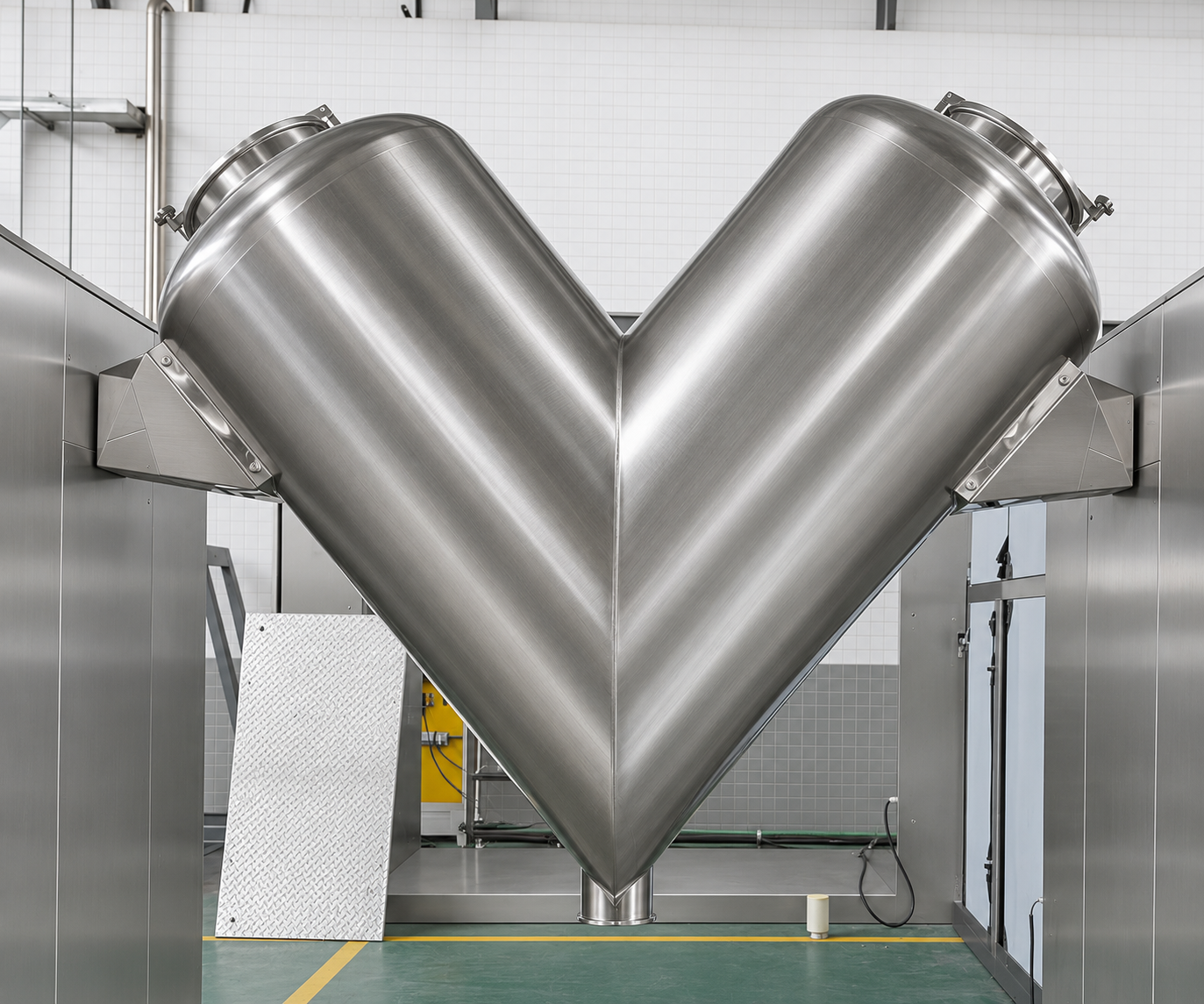
Mixing chamber
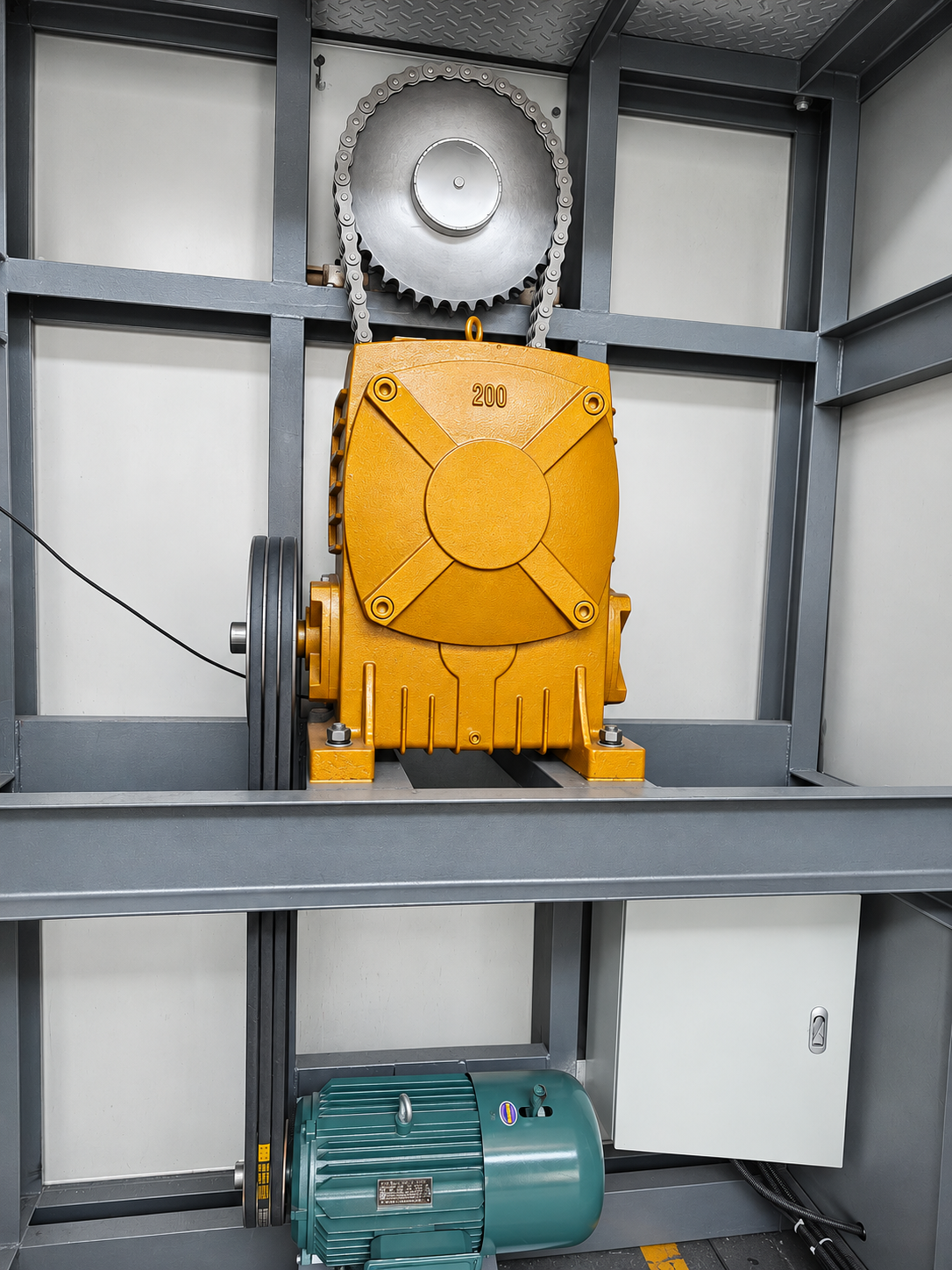
Driving unit
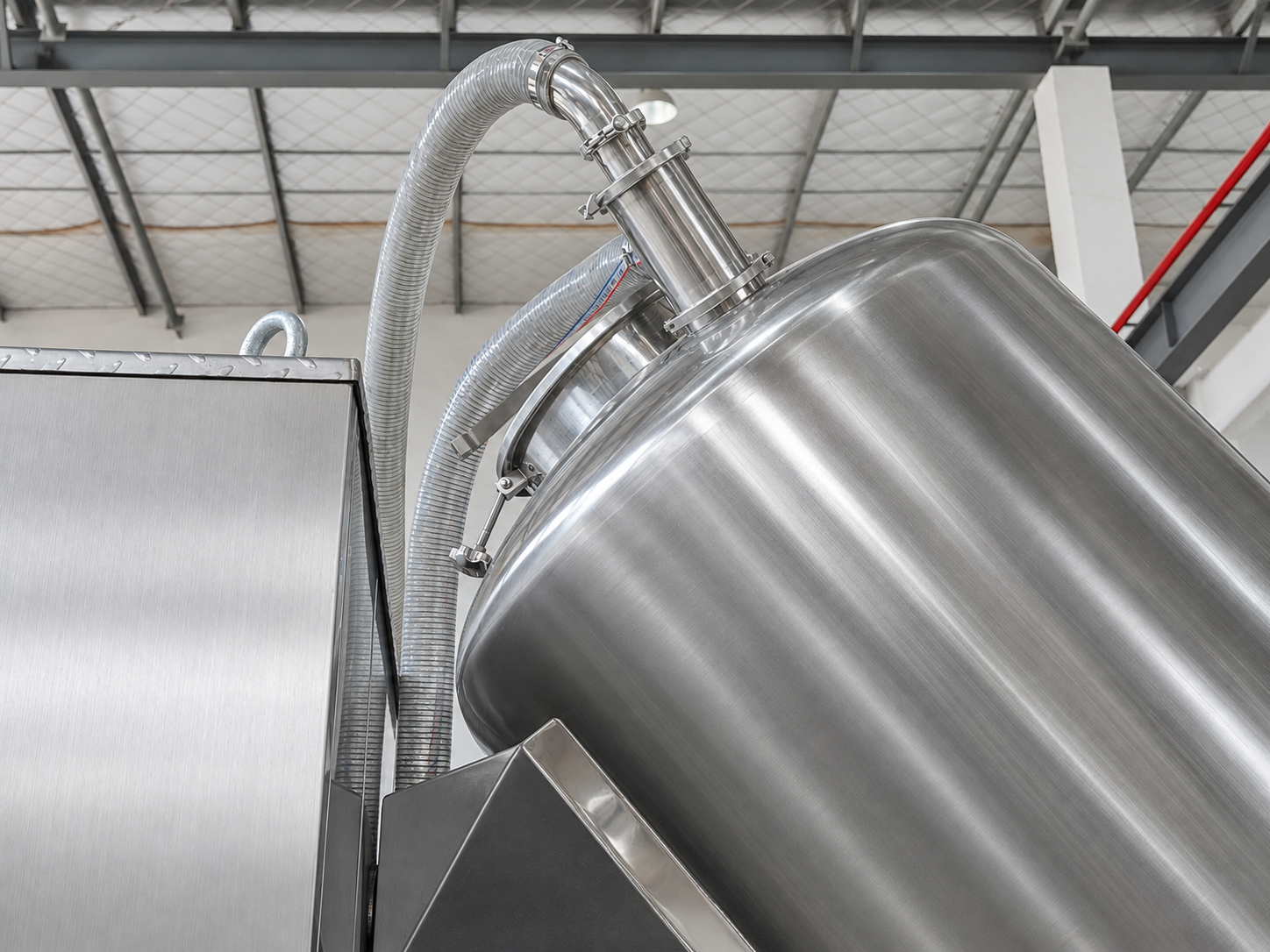
Vacuum feed port
3.Discharge Valve
The discharge valve is located at the bottom of the mixing chamber and is used to discharge the mixed powder or granules. It is usually a simple butterfly valve that is manually operated. for the medicine powder mixing process, the discharging valve needs a GMP model that can disconnect and clean each part of the valve.
5.Driving unit
the driving unit includes the motor and gearbox and chain and so on.The motor is the component of the powder mixer that drives the V-shell drum.
6.Frame
The frame is the structure that supports the mixing chamber, the agitator, and the motor. It is usually made of stainless steel or mild steel and is designed to provide stability and support to the entire mixer.
7. Control Panel
The control panel of the Y shape mixing is composed of a Start button, a Stop button, an Emergency Stop button, and power indicators.
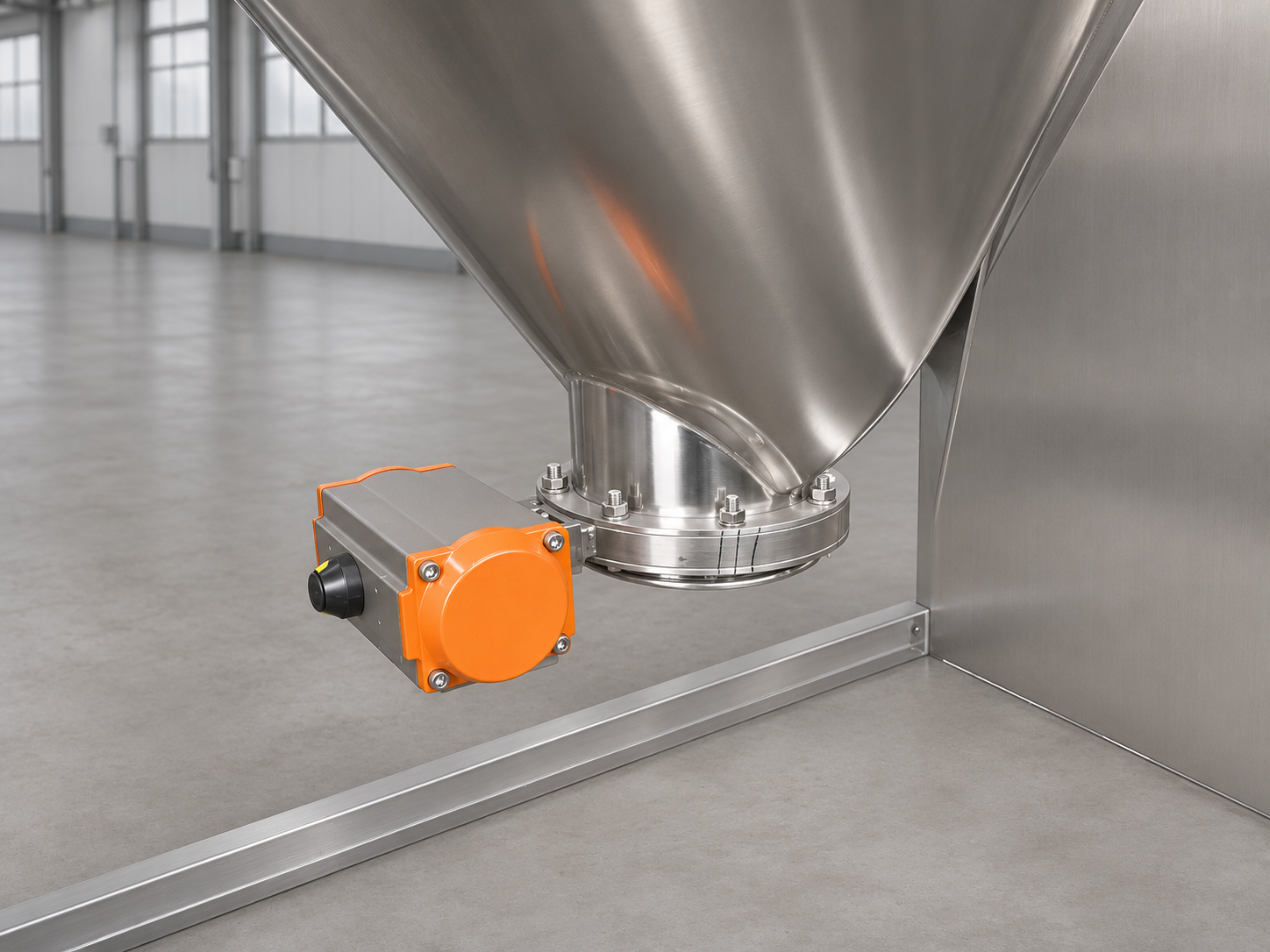
Pneumatic valve
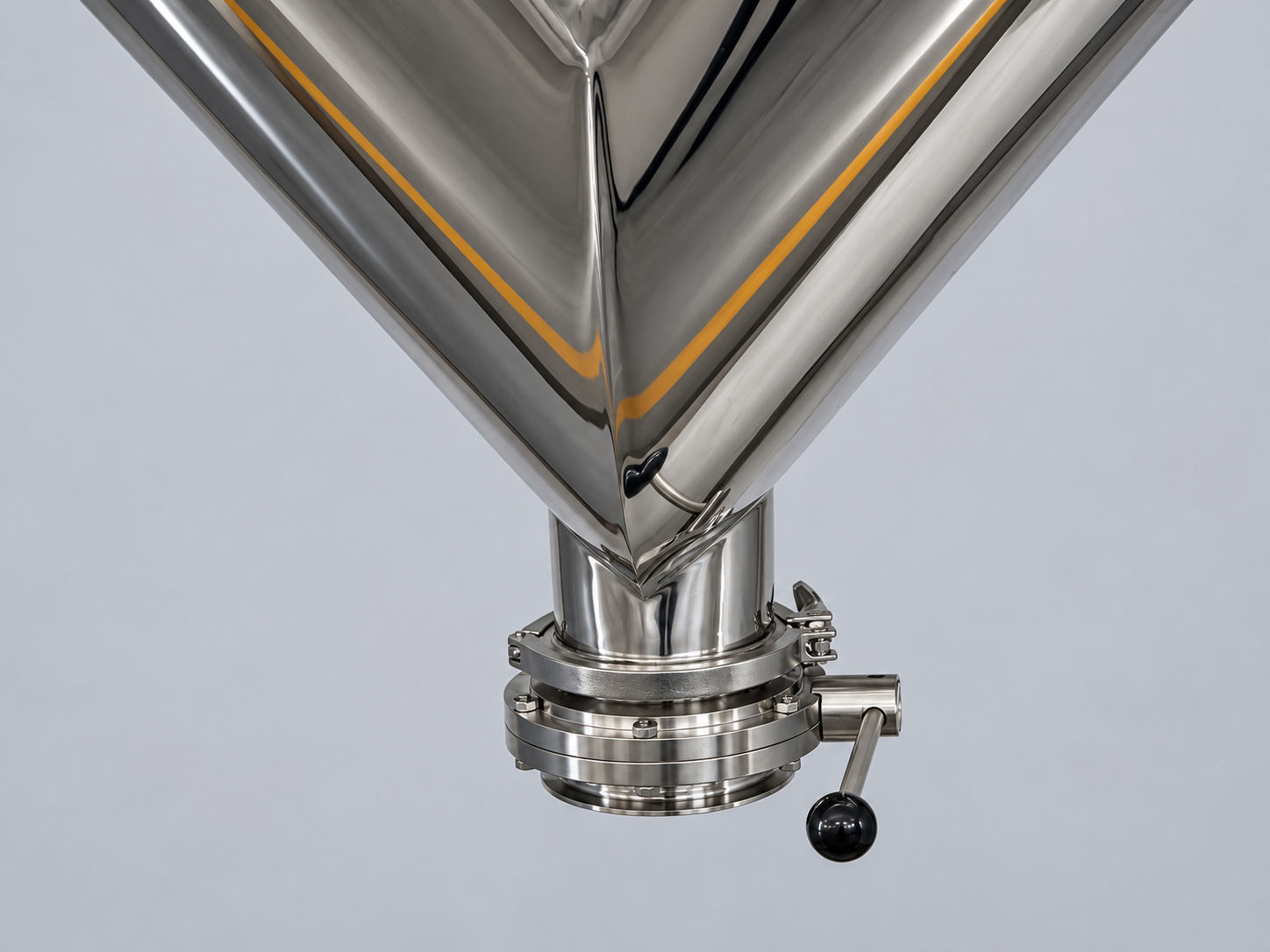
Manual valve
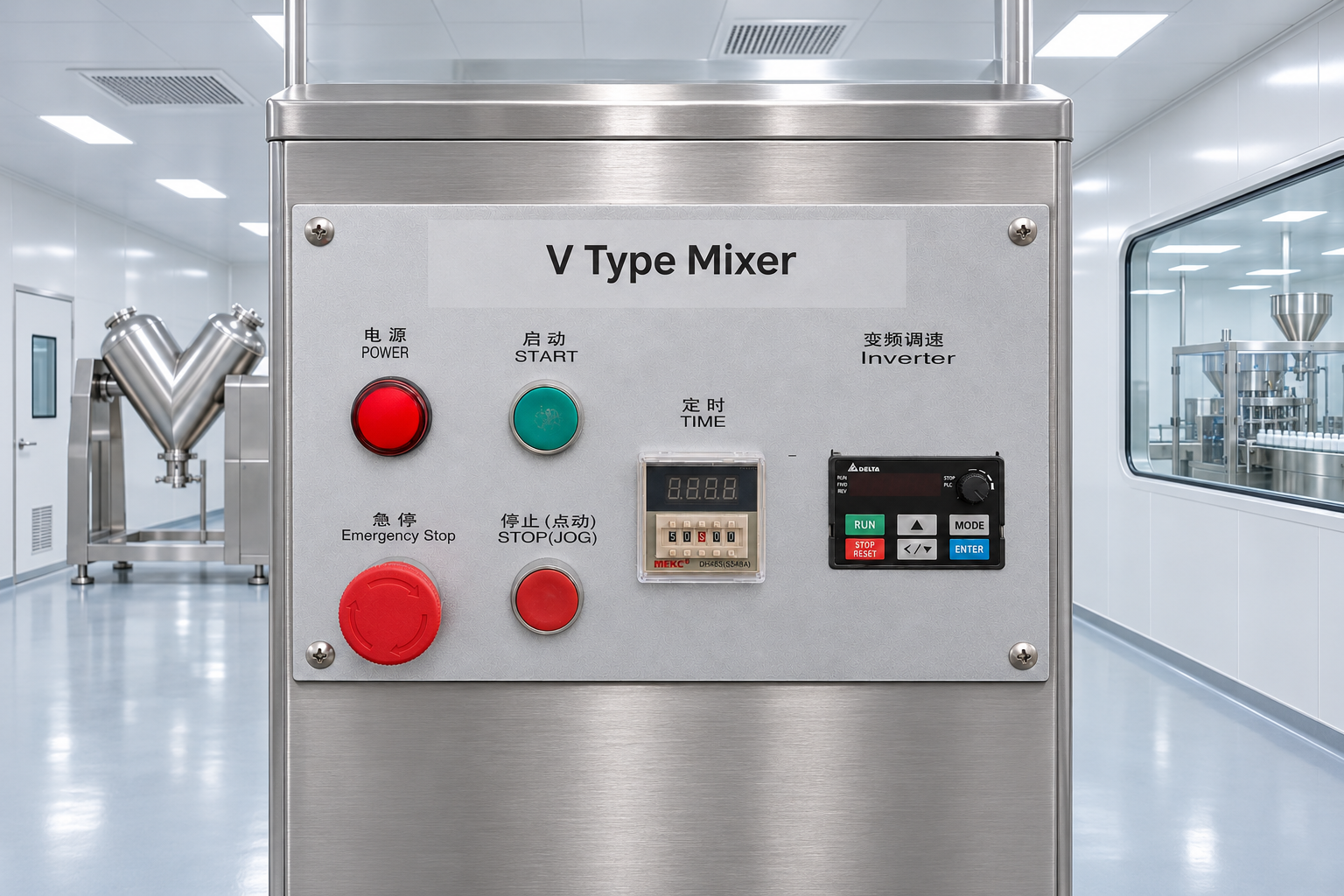
Control panel
Key Features of the V Powder Mixer
Gentle blending for dry powders and granules. The rotating V-shaped vessel repeatedly divides and recombines the batch, helping distribute free-flowing ingredients throughout the blend.
Gravity discharge and accessible cleaning. The outlet at the base of the V directs the blend through a manual or pneumatic butterfly valve. Rounded internal transitions and polished product-contact surfaces help reduce material buildup and make the vessel easier to clean.
Interchangeable vessels on selected small models. A quick-mount design lets operators switch between compatible vessels for different batch sizes or formulations. A separate vessel can be used for each formulation to simplify changeovers.
Product-contact material options. Hywell offers V-shell vessels in 304 or 316L stainless steel. Titanium and duplex stainless steel can be considered for specific applications. Surface finish, seals, and discharge valve design can be specified to suit the product and cleaning procedure.
Guarding and control options. Depending on the model, the mixer can be configured with interlocked safety guarding and either push-button or PLC touchscreen controls.
Enclosed loading and discharge options. A bag dump station and vacuum conveying system can be integrated with compatible charging and discharge connections. For oxidation-sensitive, volatile, toxic, or irritating materials, Hywell can review the required containment and protection measures for the application.
Equipment and Integration Options
1. Product-contact materials. Specify 304 or 316L stainless steel, surface finish, seals and cleaning requirements. Titanium and duplex stainless steel can be reviewed for specific applications.
2. Charging and discharge. Choose manual loading or an enclosed arrangement with a bag dump station and vacuum conveying. A compatible sealed outlet connection can transfer the blend to a receiving vessel.
3. Controls and guarding. Discuss push-button or PLC touchscreen controls, guarding, interlocks and valve actuation for the selected model.
4. Interchangeable vessels. Selected small machines can use approved interchangeable V-shell vessels. Confirm vessel size, mounting and load compatibility.
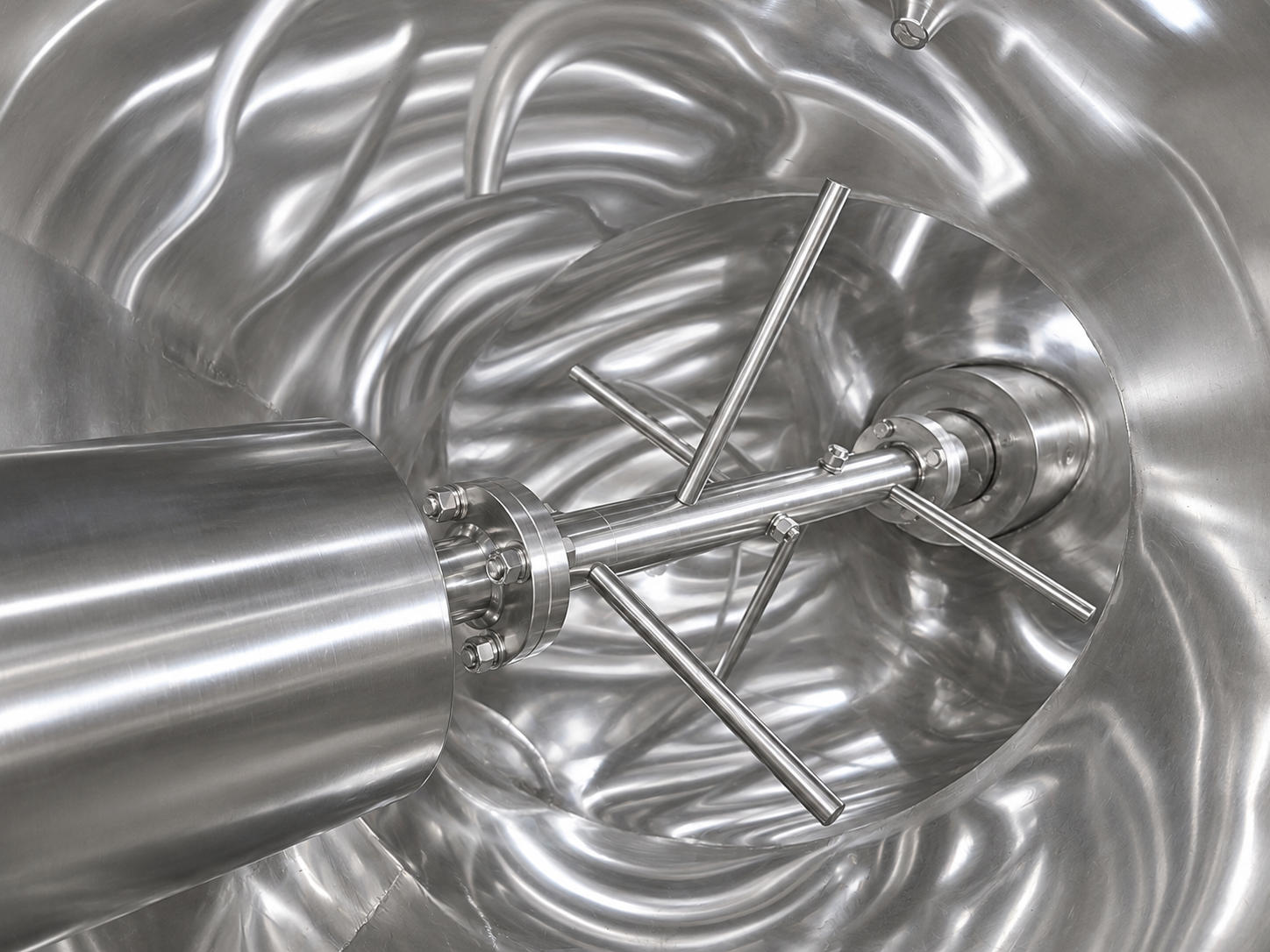
Intensifier Bars
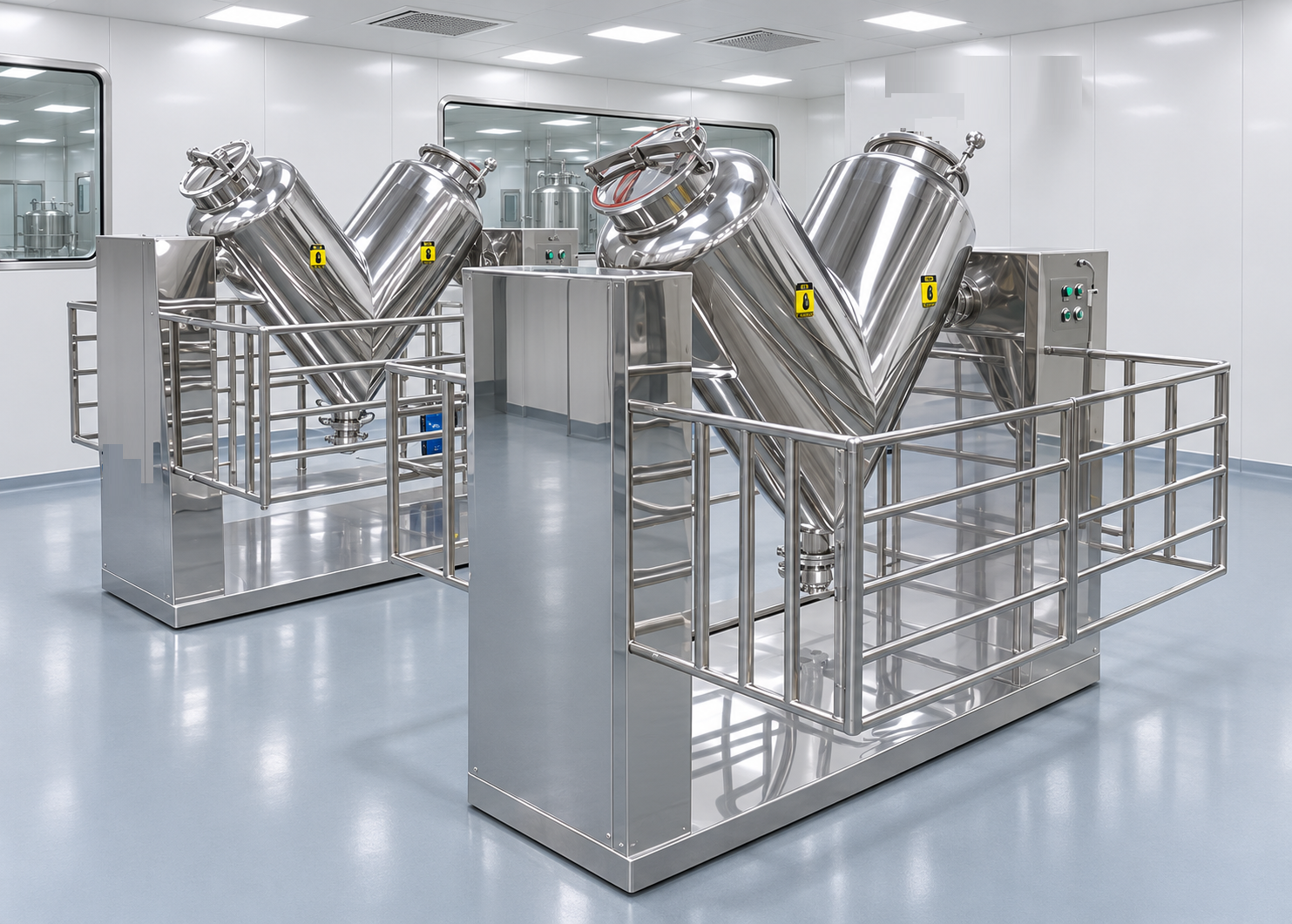
Interlock Safety Railings
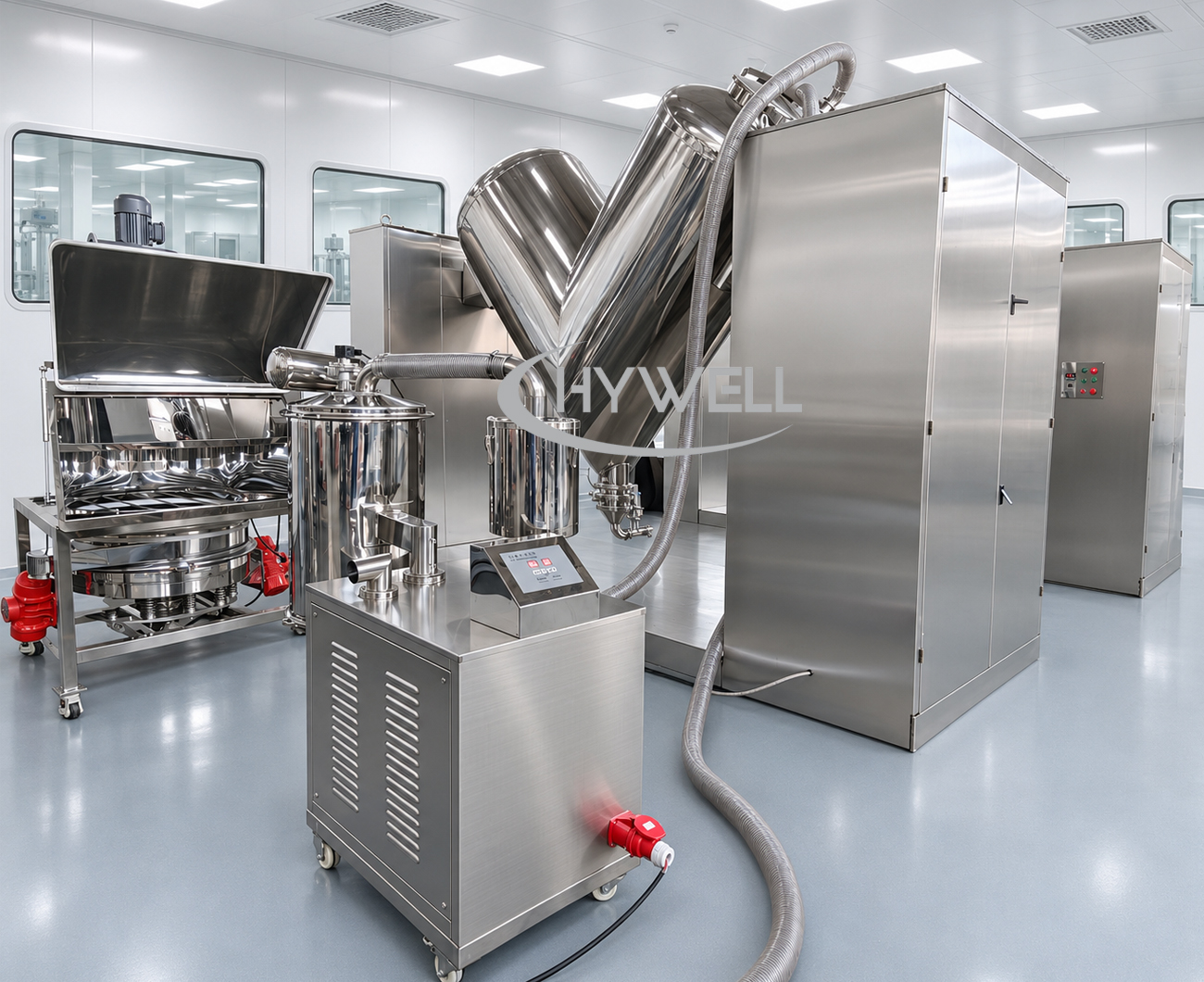 Vacuum feeder
V Powder Mixer Applications
· Pharmaceutical and nutraceutical blends. Free-flowing excipients, granules and supplement premixes.
· Food blends. Seasonings, spices, dry beverage mixes and powdered ingredients.
· Chemical and materials blends. Compatible pigments, mineral powders and plastic granules.
Advantages of Using a V Powder Mixer
There are several advantages to using a V powder mixer. These include:
• High Mixing Efficiency
The unique V-shaped design of the mixing chamber and the agitator ensures that the powder or granules are evenly mixed, and there is minimal dead space. This results in a highly efficient mixing process that saves time and energy.
• Easy to Clean
V powder mixers are easy to clean due to their simple design. The mixing chamber and the agitator can be easily accessed for cleaning, ensuring that there is no cross-contamination between batches.
• Versatile
V-type powder mixers are versatile and can be used to mix a wide range of dry powders and granules. They are commonly used in industries such as pharmaceuticals, food processing, and chemical manufacturing.
• Cost-Effective
V powder mixers are relatively affordable compared to other types of mixing machines. They also have low maintenance costs, making them a cost-effective solution for many industries.
Disadvantages of Using a V Powder Mixer
There are also some disadvantages to using a V-type powder mixer. These include:
• Limited Capacity
V-type powder mixers have a limited capacity compared to other types of mixers. They are typically used for small to medium-sized batches.
• Not Suitable for Sticky or Wet Powders
V-type powder mixers are not suitable for mixing sticky or wet powders as they can clog the agitator.
Maintenance of V Powder Mixer
Cleaning and Sanitizing
Regular cleaning and sanitizing of the V cone blender are essential to ensure its optimal performance and prevent contamination. The machine should be thoroughly cleaned after each use, using appropriate cleaning agents and methods. It should also be sanitized periodically to eliminate any microorganisms that may be present.
Lubrication and Inspection
Regular lubrication and inspection of the V powder blender machine are necessary to ensure its smooth operation and prevent wear and tear of its components. The machine should be inspected regularly for any signs of damage or wear, and the lubrication points should be checked and lubricated as needed.
Replacement of Parts
The V powder blender has several worn parts that need to be replaced periodically to maintain its optimal performance. These include the screw, the bearings, the seals, and the drive motor. It is essential to follow the manufacturer's recommendations for replacement intervals and use only genuine parts.
V Powder Mixer FAQ
Capacity and Model Selection
1. What is a V powder mixer?
A V powder mixer is a batch tumbler with two cylindrical sections joined in a V shape. Rotation repeatedly divides and recombines the powder bed to blend dry ingredients.
2. What sizes are available?
Ten listed models cover 20–3,000 L in nominal vessel volume. Configurations up to 5,000 L are available on request. Confirm working volume and maximum load for the quoted model.
3. What is the difference between nominal volume and working volume?
Nominal volume is the vessel’s total internal volume. Working volume is the listed material volume for blending. The V-500, for example, has a nominal volume of 500 L and a listed working volume of 250 L.
4. What fill ratio should I use in a V blender?
The published working volumes are 50% of nominal vessel volume for the listed models. Establish the operating fill for your formulation by checking how the material tumbles and sampling the blend.
5. Can the V-800 blend 200 kg per batch?
At 0.50 kg/L, 200 kg occupies 400 L, matching the listed working volume and load limit of the V-800. At 0.35 kg/L, the batch would occupy about 571 L and would require a larger working volume.
6. Which mixer fits 200 kg of powder at 1 g/cm³?
The powder occupies 200 L, but the standard V-400 is listed for a maximum product load of 100 kg. Share your batch weight and bulk density so Hywell can evaluate a vessel and drive configuration rated for the 200 kg batch.
7. Can one machine use different vessel sizes?
Selected small mixers can be configured with interchangeable vessels. the detail of interchangeable drum V type mixer, see the lab model V blender.
8. How does a V blender compare with a 3D powder mixer?
A V blender splits and recombines material as the V-shell rotates. A 3D mixer changes the drum orientation through a two-arm mechanism. Compare blend uniformity, discharge and cleaning with your material when selecting a machine. Hywell 3D Powder Mixer
Materials and Mixing Performance
1. Can a V blender mix powders with different particle sizes or densities?
Evaluate the actual formulation when the differences are large. Sample during trials and after discharge to see whether the blend stays uniform during transfer.
2. Can I mix ingredients at a 1:100 ratio?
Treat 1:100 as a trial condition. Ingredient properties, fill level and loading sequence influence the result. Consider a staged premix and agree on the sampling and acceptance criteria.
3. How long does a blending cycle take?
Mixing time depends on the formulation, fill level, rotation speed and target uniformity. Sample at intervals during a trial to find the time needed for your blend.
4. How can I verify mixing uniformity?
Agree on the ingredient to measure, the sampling locations and sample size, and the acceptance limit. Report the relative standard deviation (RSD) when appropriate.
5. What does an intensifier bar do?
The optional intensifier bar applies local agitation to help break up soft agglomerates. Evaluate its effect on particle size and blend quality if your material is fragile.
6. Can a V blender add liquid to dry powder?
Hywell can review a spray-nozzle configuration for a specified liquid addition. Provide the liquid percentage, viscosity and desired end condition so the process can be assessed.
7. Is a V blender suitable for sticky or cohesive powders?
V blenders generally work best with free-flowing materials. For a sticky or cohesive powder, evaluate buildup and lump formation in a trial before choosing the mixer.
Configuration and Installation
1. Can the mixer be loaded and discharged through a closed system?
Yes, with compatible docking connections and conveying equipment. Hywell can review the feeding station, vacuum conveyor, discharge valve and receiving vessel as a system.
2. What product-contact materials can I specify?
304 and 316L stainless steel are available. Specify the surface finish, seal material and documentation needed for your process.
3. How do I clean the mixer between batches?
Include the vessel interior, charging covers, seals and discharge valve in the cleaning procedure. If the machine has an intensifier bar, include its product-contact surfaces as well.
4. Can I choose manual or pneumatic discharge?
Both butterfly valve options can be reviewed. Provide the downstream connection size and describe how discharge should be initiated.
5. How much room does a V powder mixer need?
Ask for the layout drawing showing the rotating envelope, guarding and clearance for loading, discharge and maintenance. Use the overall dimensions in the table for preliminary planning.
6. Can Hywell configure the machine for a hazardous area?
Provide the site area classification, material properties and required documentation. Hywell can review the equipment scope and applicable protection measures for the specified installation.
7. What information is needed for a quote?
Send the material name, loose bulk density, target and minimum batch weights, desired blend quality and available installation space. Include contact materials, cleaning needs and charging and discharge requirements.
Request a Quote for a V Powder Mixer
Send Hywell your batch weight, loose bulk density and process requirements so we can review the working volume, load rating and equipment options. Contact Hywell Machinery.
 Русский
 English
 العربية
 Français
 Español
 Português
 Deutsch
 italiano
 日本語
 한국어
 Nederlands
 Tiếng Việt
 ไทย
 Polski
 Türkçe
 ພາສາລາວ
 Bahasa Melayu
 Filipino
 Bahasa Indonesia
 magyar
 Română
 Čeština
 қазақ
 Српски
 हिन्दी
 فارسی
 Slovenčina
 Slovenščina
 Norsk
 Svenska
 українська
 Ελληνικά
 Suomi
 Հայերեն
 עברית
 Dansk
 اردو
 বাংলা
 Hrvatski
 Afrikaans
 Gaeilge
 Eesti keel
 Māori
 नेपाली
 Oʻzbekcha
 latviešu
 Azərbaycan dili
 Беларуская мова
 Български
 ქართული
 Kurdî
 Кыргызча


 简体中文

 简体中文


 Vacuum feeder