The Challenge of Mixing Materials with Different Particle Sizes
In industries such as pharmaceuticals, food processing, nutraceuticals, chemicals, and battery materials, achieving a homogeneous powder blend is often more challenging than expected. One of the most common reasons is the significant difference in particle size between ingredients.
Typical examples include:
Mixing 2–3 mm granules with 200–300 mesh powder
Blending coarse carrier particles with micronized active ingredients
Adding trace powders to larger granulated products
Combining fine additives with instant beverage granules
Many manufacturers find that the mixture appears uniform immediately after blending, but segregation occurs during discharge, conveying, packaging, or transportation. In most cases, the root cause is not the powder mixer itself, but the particle size difference between materials.
Why Do Different Particle Sizes Cause Segregation?
When materials of different particle sizes are mixed, smaller particles tend to move downward through the void spaces between larger particles, while larger particles gradually migrate upward.
For example:
Material | Particle Size |
Granules | 2–3 mm |
Fine Powder | 200–300 mesh (48–75 μm) |
Mark: In this case, the particle size ratio can exceed 30:1 and may reach over 60:1. |
Although the blend may initially pass uniformity testing, vibration and handling during downstream processing can cause the materials to separate again.
This phenomenon is widely recognized in powder technology as:
Percolation Segregation
The Brazil Nut Effect
The greater the particle size difference, the higher the risk of segregation.
Recommended Particle Size Ratios for Uniform Powder Mixing
Based on practical industrial experience, particle size ratio plays a critical role in blend quality.
Particle Size Ratio | Mixing Performance |
Less than 2:1 | Excellent |
2:1 to 5:1 | Very Good |
5:1 to 10:1 | Acceptable |
10:1 to 20:1 | High Segregation Risk |
Above 20:1 | Severe Segregation Risk |
For example:
500 μm mixed with 1,000 μm particles generally blends well.
200 μm mixed with 2,000 μm particles may show noticeable segregation.
50 μm powder mixed with 3,000 μm granules usually requires special processing methods.
For industries requiring high content uniformity, controlling particle size distribution is often more important than increasing mixing time.
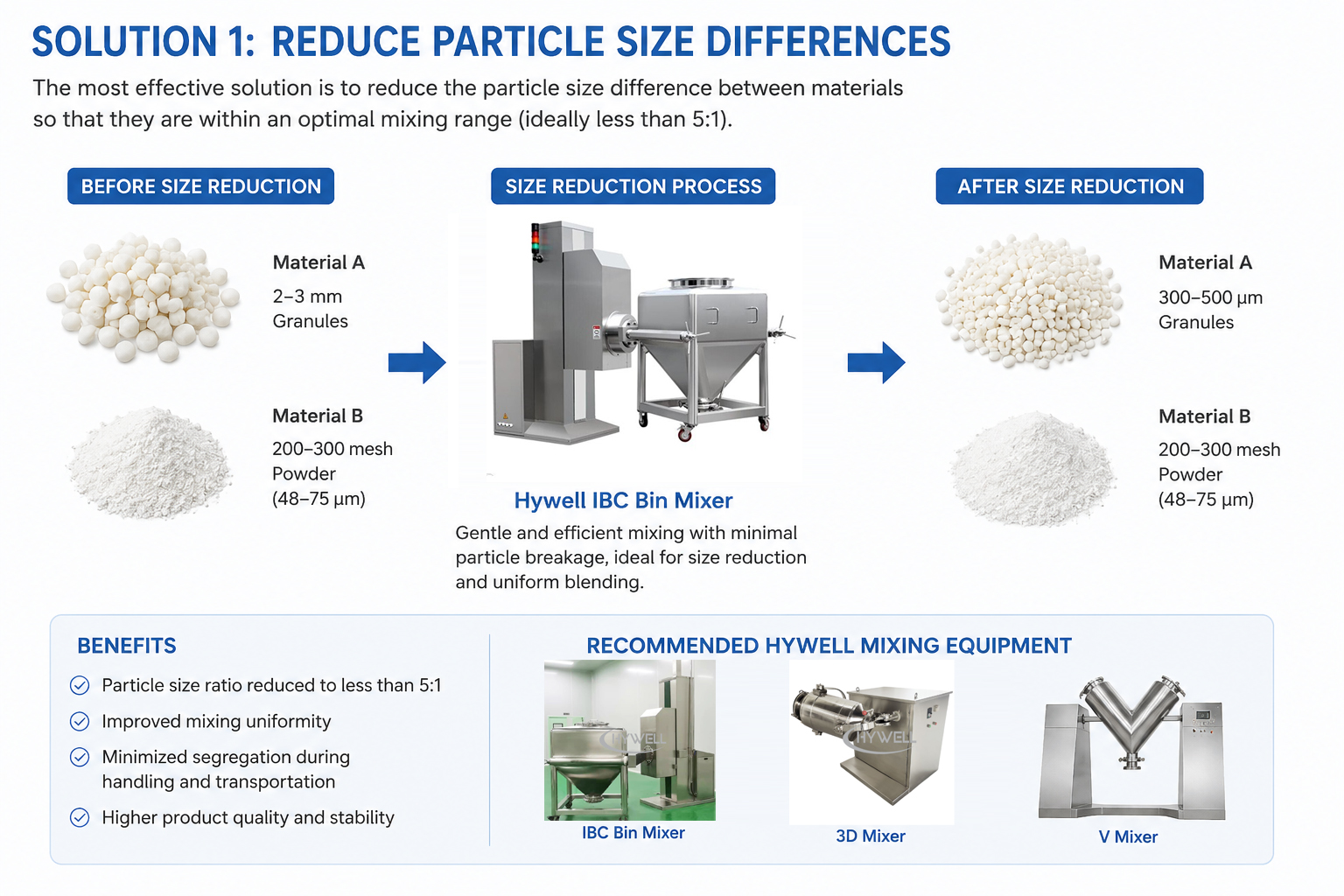
Solution 1: Reduce Particle Size Differences
The most effective approach is to make the particle sizes as similar as possible.
For example:
Original materials:
After size reduction:
By reducing the particle size ratio to below 5:1, blend uniformity can be significantly improved while minimizing segregation during storage and transport.
This is often the preferred solution in pharmaceutical and specialty chemical manufacturing.
Solution 2: Granulate Fine Powders Before Mixing
When large granules cannot be reduced in size, another effective option is to enlarge the fine powder particles through granulation.
For example:
Before granulation:
After granulation:
Common equipment used includes:
By bringing particle sizes closer together, blend stability improves dramatically.
Solution 3: Use an IBC Bin Mixer for Gentle and Segregation-Free Blending
For fragile granules and sensitive formulations, excessive mechanical agitation can create additional fines and worsen particle size differences.
An IBC Bin Mixer is often the preferred solution because it provides gentle tumbling action without high shear forces. Hywell machinery have the completed powder mixing line to process the close mixing and transfer.
Advantages of an IBC Bin Mixer
Gentle Mixing Action
Unlike ribbon mixers or paddle mixers, an IBC Bin Blender rotates the entire container, allowing materials to flow naturally.
Benefits include:
This makes it particularly suitable for:
Pharmaceutical granules
Nutraceutical products
Instant beverage powders
Food ingredients
Battery materials
Reduced Material Transfers
In traditional processing:
Mixer → Transfer Bin → Packaging
Each transfer step increases the risk of segregation.
With an IBC Bin Mixer, the same container can be used for:
This significantly reduces product handling and maintains blend uniformity.
Flexible Batch Sizes
Modern IBC blending systems can accommodate interchangeable bins of various capacities, allowing one mixer to handle multiple batch sizes efficiently.
IBC Bin Mixer for Gentle and Segregation Video
Practical Recommendations for Industrial Powder Mixing
Based on years of industrial blending experience:
Best Results
Particle size ratio:
2:1 to 5:1
Typically provides the most stable and uniform blend.
Acceptable Results
Particle size ratio:
5:1 to 10:1
May require optimized mixing parameters and careful handling.
High-Risk Formulations
Particle size ratio:
Above 10:1
Often requires particle size modification, granulation, or coating techniques.
Critical Cases
Particle size ratio:
Above 20:1
Mixing time alone will not solve the problem. Process design becomes essential.
Conclusion
Uniform powder mixing is not determined solely by the type of mixer. The relationship between particle size, particle size distribution, and material characteristics has a much greater impact on final blend quality.
For formulations with relatively similar particle sizes, equipment such as an IBC Bin Mixer, IBC Bin Blender, or 3D Powder Mixer can achieve excellent mixing uniformity while minimizing particle damage.
For formulations with large particle size differences, successful blending often requires a combination of:
By selecting the right process and mixing equipment, manufacturers can significantly improve content uniformity, reduce segregation, and ensure consistent product quality throughout production, packaging, and transportation.

 Русский
 English
 العربية
 Français
 Español
 Português
 Deutsch
 italiano
 日本語
日本語 한국어
한국어 Nederlands
 Tiếng Việt
 ไทย
ไทย Polski
 Türkçe
 ພາສາລາວ
 Bahasa Melayu
 Filipino
 Bahasa Indonesia
 magyar
 Română
 Čeština
 қазақ
қазақ Српски
 हिन्दी
 فارسی
فارسی Slovenčina
 Slovenščina
 Norsk
Norsk Svenska
 українська
 Ελληνικά
 Suomi
Suomi Հայերեն
 עברית
עברית Dansk
Dansk اردو
اردو বাংলা
বাংলা Hrvatski
 Afrikaans
 Gaeilge
 Eesti keel
 Māori
Māori नेपाली
 Oʻzbekcha
 latviešu
 Azərbaycan dili
 Беларуская мова
 Български
 ქართული
 Kurdî
Kurdî Кыргызча


 简体中文
简体中文