Achieving consistent, high-quality powder blends is a critical requirement across industries such as pharmaceuticals, food, chemicals, and specialty materials. Selecting the right industrial powder mixer directly impacts mixing uniformity, batch efficiency, product quality, safety, and regulatory compliance.
Hywell Machinery, a leading manufacturer of industrial powder mixers, offers a comprehensive range of solutions tailored to diverse production needs. Their product lineup includes the IBC Bin Blender for direct mixing in large containers, the 3D Powder Mixer (SYH Series) for precise multi-dimensional blending, and the V Powder Mixer for efficient free-flowing powder mixing. With these solutions, Hywell ensures reliable production, precise mixing uniformity, optimized batch efficiency, and compliance with industry standards, helping manufacturers minimize waste, enhance product quality, and maintain operational safety.
A well-chosen mixer also supports operational scalability, allowing manufacturers to adapt to changing production demands. This guide provides a comprehensive approach to selecting the ideal powder blending equipment for your production needs.
1. Understanding Powder Characteristics for Optimal Mixing
The foundation of choosing the right powder mixer lies in understanding the physical properties of the materials to be processed. These characteristics influence not only the type and configuration of the mixer but also the mixing strategy itself.
1.1 Bulk Density
Accurate knowledge of bulk density is essential for determining the effective capacity of an industrial powder mixer. High-density powders require robust construction to handle weight, while low-density powders may necessitate specific designs to prevent segregation during mixing. Overloading a mixer can compromise mixing uniformity, while underloading may reduce batch efficiency. Some materials may have varying bulk densities depending on humidity or storage conditions, so it is critical to measure and verify the bulk density before specifying mixer size.
1.2 Flowability and Adhesion
The natural flow behavior of powders, classified as excellent, good, fair, or poor, directly impacts how materials move inside the mixer. Poor-flowing powders may require specialized agitators or ploughshare blades to eliminate dead zones and ensure complete blending. Additionally, some powders exhibit strong adhesion to vessel walls, increasing residual material and cleaning effort. Selecting mixers with polished stainless steel surfaces or anti-stick coatings helps maintain both mixing uniformity and operational efficiency. In practice, powders with high cohesion, such as fine sugars, starches, or pharmaceutical actives, require slower mixing speeds or specialized blade designs to prevent clumping and ensure uniform dispersion.
1.3 Particle Size and Density Variations
Materials with a wide range of particle sizes or densities pose additional challenges. Without proper mixer design, segregation can occur, particularly during discharge. Multi-dimensional mixers or those with specialized internal baffles can help ensure uniform distribution of heavy and light particles, maintaining both product quality and regulatory compliance. Materials with a wide range of particle sizes or densities pose additional challenges. Without proper mixer design, segregation can occur, particularly during discharge. Multi-dimensional mixers or those with specialized internal baffles can help ensure uniform distribution of heavy and light particles, maintaining both product quality and regulatory compliance.
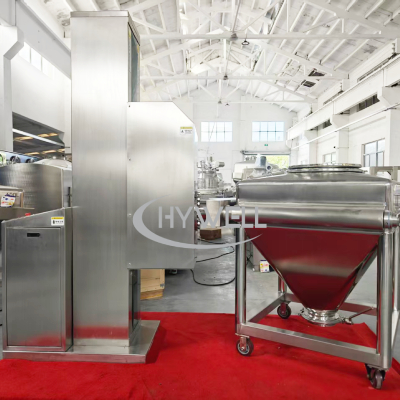
IBC Bin Blender
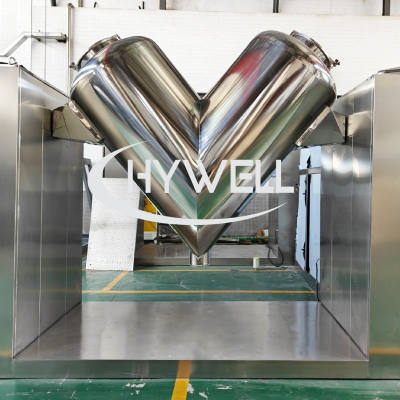
V Powder Mixer
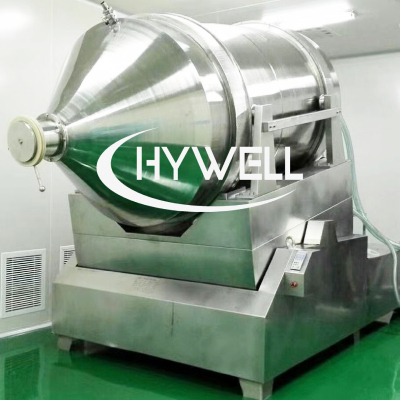
2D Powder Mixer
2. Determining Mixing Capacity and Batch Efficiency
Mixing capacity defines how much material can be processed per batch and is a crucial consideration for production planning.
2.1 Batch Size and Throughput
Production targets determine the required mixing capacity. The pharmaceutical industry typically requires small batches with precise material control, while the chemical and food industries may process thousands of kilograms per batch. Selecting an appropriately sized industrial powder mixer ensures optimal batch mixing efficiency without compromising product quality.
2.2 Mixing Uniformity and Time
Achieving consistent mixing uniformity is a key performance indicator for any powder blending equipment. Manufacturers should define acceptable relative standard deviation (RSD), commonly ≤5%, to measure homogeneity. Additionally, maximum mixing time per batch must be balanced to avoid overmixing, which may cause particle degradation or segregation, and undermixing, which risks inconsistent product quality. High-efficiency mixers designed for both rapid and uniform blending help maintain batch consistency and improve overall production efficiency.
2.3 Case Example
In the powder mixing process of biopharmaceutical production, uniformity is crucial to ensure that each unit of product contains the correct dosage of ingredients. Hywell's IBC bin mixer achieves a 10,000:1 ratio of primary to excipient materials with a mixing time of only 20 minutes, while attaining an RSD ≤ 11%. This significantly enhances batch efficiency and product quality. Such a high material ratio achieving this RSD value is highly satisfactory.
3. Material Handling and Integration with Production Lines
Efficient material handling is key to the performance of industrial powder mixers. Seamless integration with upstream and downstream processes enables fully enclosed feeding and discharging, thereby reducing the risk of contamination.
3.1 Feeding Systems
There are several common feeding methods for powder mixing machines: manual feeding, vacuum (negative pressure) feeding, screw feeding, and gravity feeding from the second floor.
3.1.1 Manual feeding
Manual feeding is typically used for small-scale mixers, where the batch size is relatively small and manual loading is the most convenient and flexible option. It requires minimal setup and is suitable for laboratory or small production environments.
3.1.2 Vacuum feeder feeding
Vacuum (negative pressure) feeding is a dust-free and efficient solution, often used together with a dust-free feeding station or a bulk bag unloading station. This method is ideal for medium and large-scale mixers, as it can significantly reduce dust emissions, improve workplace cleanliness, and enhance automation.
3.1.3 Screw feeding
Screw feeding is suitable for transferring materials with poor flowability over short distances, providing stable and continuous feeding. Gravity feeding from a second-floor platform is the most efficient and clean option when the layout allows, as materials can flow directly into the mixer without additional mechanical conveying.
Overall, the choice of feeding method depends on production scale, plant layout, material characteristics, and cleanliness requirements.
3.2 Discharge Systems
Discharging from a mixer is essentially a gravity-based process, but the key challenges for customers usually involve controlling dust during discharge and efficiently transferring materials to the next processing step.
3.2.1 IBC bin lifter discharging
For example, Hywell's IBC Bin Mixer offers two main discharge solutions. The first is a closed discharge directly to a packaging machine. In this setup, Hywell provides a bin lifter to raise the IBC bin to the required feeding height of the packaging machine, ensuring a sealed and dust-free connection.
3.2.2 Docking station discharging
The second option is to discharge through a docking station. In this case, the IBC bin is moved to the discharge station, where the valve is opened and the station connects to a vacuum conveying system. The material is then transferred in a fully enclosed manner to the next piece of equipment, preventing dust emission and contamination.
Different types of mixers may use different discharge systems depending on the production process and plant layout. Hywell welcomes customers to consult us for customized discharge and material handling solutions.
3.3 Process Integration
Modern powder blending equipment often supports fully automated workflows. Connecting mixers with upstream milling or screening equipment and downstream filling or tablet pressing systems enables continuous production while maintaining precise batch records and process control. Integrated systems can also optimize energy use, reduce labor costs, and maintain GMP-compliant mixing processes by limiting manual intervention.
3.4 Example in Food Industry
In the production of instant coffee powder mixtures, integrating a drum lift mixer with an upstream dust-free feeding station and downstream packaging line ensures product consistency while minimizing dust emissions. Automation also enables precise control of micro-ingredients such as vitamins or flavorings to maintain formulation accuracy. For a detailed process demonstration, please refer to the video.
4. Compliance, Construction, and Surface Treatment
Meeting industry standards and ensuring durable construction are key considerations when selecting powder blending equipment.
4.1 Regulatory Compliance
In pharmaceutical and food industries, mixers must support GMP-compliant mixing practices. This includes traceable batch records, controlled environments, and validated cleaning procedures. Compliance reduces contamination risk and facilitates regulatory inspections. Mixers designed for GMP compliance often feature smooth, rounded internal corners to eliminate dead zones and prevent microbial growth.
4.2 Material and Surface Quality
The construction material affects corrosion resistance, durability, and contamination potential. 304 and 316L stainless steel are standard, with 316L preferred for highly corrosive or sterile applications. Surface treatment is equally important: mechanical polishing (Ra ≤ 0.8µm) or electropolishing (Ra ≤ 0.4µm) minimizes powder adhesion, simplifies cleaning, and maintains mixing uniformity. Specialized coatings or non-stick linings may be applied for powders with high stickiness or abrasion.
4.3 Design Features Enhancing GMP Compliance
Features such as removable agitators, sanitary seals, and quick-release discharge valves facilitate cleaning and reduce cross-contamination risk. Some mixers also incorporate CIP-compatible spray nozzles to enable complete cleaning without disassembly, saving time and maintaining batch integrity.
5. Cleaning, Sterilization, and Maintenance
Effective cleaning and sterilization strategies are vital for maintaining product quality and ensuring regulatory compliance.
5.1 Cleaning Methods
Mixers may be cleaned manually, semi-automatically, or via fully automated Clean-in-Place (CIP) systems. CIP-equipped industrial powder mixers reduce downtime and minimize the risk of cross-contamination. Semi-automatic systems often combine manual access with automated spray cycles, balancing labor effort and cleaning efficiency.
5.2 Sterilization Options
For sensitive or sterile applications, additional sterilization measures, such as steam sterilization, chemical disinfectants, or dry heat, may be required. These processes are especially important for pharmaceutical, enzyme, or probiotic powders that must remain free from microbial contamination.
5.3 Maintenance Accessibility
Ease of maintenance influences long-term operational efficiency. Mixers designed for quick access to bearings, seals, motors, and agitators reduce downtime and support continuous production. Preventive maintenance schedules, including lubrication, inspection, and replacement of wear parts, are critical to ensure consistent mixing uniformity and prolong equipment life. Some high-end mixers incorporate sensors to monitor motor load, blade wear, and vibration, enabling predictive maintenance.
6. Safety, Explosion Prevention, and Automation
Handling powders can pose significant safety risks, particularly with flammable, combustible, or toxic materials.
6.1 Explosion and Fire Safety
Mixers handling hazardous powders must comply with industrial safety standards, including ATEX-rated designs (e.g., Ex d IIB T4) and inert gas blanketing. Proper grounding, ventilation, and explosion relief panels further reduce risk. For highly combustible powders, such as fine sugar, starch, or metallic powders, nitrogen purging or explosion suppression systems may be integrated.
6.2 Automation and Control
Automation enhances both safety and operational consistency. PLC-controlled industrial powder mixers with touchscreens provide precise control over mixing parameters, alarm notifications, batch tracking, and recipe management. Automated systems reduce human error, maintain GMP-compliant mixing processes, and improve batch mixing efficiency. Integration with Manufacturing Execution Systems (MES) allows real-time monitoring and full traceability, essential for regulated industries.
6.3 Example in Pharmaceuticals
A PLC-controlled ribbon mixer with integrated CIP, batch recording, and inert gas protection can handle multiple drug formulations, switching between batches without cross-contamination. This ensures consistent mixing uniformity and compliance with stringent quality standards.
7. Conclusion: Choosing the Right Powder Mixer
Selecting the ideal industrial powder mixer requires a systematic assessment of material properties, batch size, mixing uniformity requirements, material handling methods, regulatory compliance, cleaning procedures, and safety standards. A well-designed powder blending system ensures consistent product quality, operational efficiency, and compliance with industry regulations.
By understanding the interplay between material characteristics, mixer design, and operational requirements, manufacturers can make informed decisions that optimize production workflows and enhance batch mixing efficiency. Whether for pharmaceuticals, food, chemicals, or specialty materials, investing in the right industrial powder mixer is an investment in reliable, reproducible, and high-quality production.
With careful selection, industrial powder mixers not only deliver superior mixing uniformity but also streamline production processes, minimize waste, and support scalable operations. Detailed attention to material handling, automation, surface treatment, and cleaning protocols ensures that every batch meets exacting quality standards while maintaining safety and efficiency. Ultimately, the right equipment provides long-term value, supporting sustainable and compliant manufacturing across industries.

 Русский
 English
 العربية
 Français
 Español
 Português
 Deutsch
 italiano
 日本語
日本語 한국어
한국어 Nederlands
 Tiếng Việt
 ไทย
ไทย Polski
 Türkçe
 ພາສາລາວ
 Bahasa Melayu
 Filipino
 Bahasa Indonesia
 magyar
 Română
 Čeština
 қазақ
қазақ Српски
 हिन्दी
 فارسی
فارسی Slovenčina
 Slovenščina
 Norsk
Norsk Svenska
 українська
 Ελληνικά
 Suomi
Suomi Հայերեն
 עברית
עברית Dansk
Dansk اردو
اردو বাংলা
বাংলা Hrvatski
 Afrikaans
 Gaeilge
 Eesti keel
 Māori
Māori नेपाली
 Oʻzbekcha
 latviešu
 Azərbaycan dili
 Беларуская мова
 Български
 ქართული
 Kurdî
Kurdî Кыргызча


 简体中文
简体中文