In modern pharmaceutical, food, and chemical industries, the processing and formation of powder materials are essential steps in production. As production scales increase and quality standards become more stringent, granulation equipment technology continues to evolve and improve. Among various granulation methods and devices, the Swing Granulator—sometimes referred to as a Oscillating Granulator, Rotary Swing Granulator, Rocking Granulator, or Swinging Granulation machine, stands out for its simple structure, reliable operation, and broad applicability, making it an indispensable piece of equipment in many manufacturing processes. Hywell Machinery introduces its Oscillating Granulator, a reliable and efficient solution for turning powders into uniform granules. Easy to operate and maintain, this machine is widely used in pharmaceutical, food, chemical, and nutraceutical production.
This article provides an in-depth look at the working principle, technical advantages, application areas, and future development trends of the Swing Granulator, offering readers a comprehensive understanding of this technology.
1. Technical Principles of Oscillating Granulation
Oscillating granulation is classified as a wet granulation technique, in which fine powders are converted into cohesive, uniform granules through controlled mechanical motion and binder application. Unlike high-shear mixers, which rely on rapid rotation and intense friction, rotary oscillating granulators employ gentle, controlled back-and-forth or swinging movements that promote gradual particle aggregation.
1.1 Mechanical Design and Oscillatory Motion
A standard oscillating granulator comprises several core components:
· Oscillating Plate or Disc: The plate generates controlled motion that can be adjusted in amplitude, frequency, and angle. The movement ensures that particles continuously collide and mix without excessive force.
· Powder Feed System: Raw materials are delivered at a consistent rate, preventing uneven granule formation and ensuring a homogeneous mixture.
· Binder Spray System: Precise spraying mechanisms distribute liquid binder uniformly across the oscillating powder bed.
· Screening and Sieving Units (Optional): Oversized or undersized granules are removed to maintain consistent granule size distribution.
The oscillatory motion creates a combination of shear, collision, and compression forces that encourage fine powders to adhere and aggregate into granules. By adjusting oscillation frequency (typically measured in cycles per minute), amplitude (distance of oscillation), and oscillation angle, operators can precisely tailor granule size, shape, density, and hardness to meet the specific requirements of the material and end product.
1.2 Binder Application and Particle Adhesion
The application of a liquid binder is a critical factor in swing granulation. Uniform wetting ensures that particles adhere evenly, preventing the formation of large agglomerates or fines. Spray systems are often synchronized with the oscillating motion so that each particle receives consistent exposure to the binder. The result is a more homogeneous granule with controlled moisture content and improved mechanical strength.
Various binders can be employed depending on material sensitivity, solubility requirements, and downstream applications. For pharmaceuticals, water-soluble polymers such as hydroxypropyl cellulose (HPC) or polyvinylpyrrolidone (PVP) are commonly used, while chemical or fertilizer granules may utilize aqueous or solvent-based adhesives.
1.3 Granule Formation Mechanisms
The formation of granules in a rotary swing granulator involves several simultaneous physical processes:
· Particle Collision: Fine powders are constantly moved by oscillation, promoting repeated collisions that initiate particle aggregation.
· Adhesion: Binder creates liquid bridges between particles, facilitating adhesion and initial granule formation.
· Growth and Consolidation: Repeated collisions and gentle compaction increase granule size and density, forming a stable structure.
· Breakage Prevention: Unlike high-shear processes, the gentle oscillatory motion reduces stress on particles, minimizing breakage and preserving sensitive compounds.
2. Technological Advantages of Oscillating Granulators
The adoption of swing granulation is largely driven by its technological superiority over traditional granulation methods. These advantages encompass granule quality, operational efficiency, energy conservation, material versatility, and overall manufacturing sustainability.
2.1 Granule Uniformity and Flowability
One of the most significant benefits of oscillating granulation is the production of uniform granules with consistent size, shape, and density. Uniformity is critical for downstream processes, including tablet compression, capsule filling, coating, packaging, and blending. Non-uniform granules can lead to dosing inaccuracies, coating defects, poor solubility, or bridging in hoppers and feeders.
For example, in pharmaceutical tablet manufacturing, granules produced by swing granulation exhibit controlled particle size distribution, ensuring each tablet receives a consistent dosage. Additionally, uniform density enhances compressibility, producing tablets with high mechanical strength and minimal capping or lamination defects. In chemical applications, uniform granules facilitate easier storage, transport, and dissolution, improving product usability and customer satisfaction.
2.2 Energy Efficiency and Reduced Operational Costs
Compared to high-shear mixers or conventional rotary granulators, rotary oscillating granulators consume significantly less energy while maintaining granule quality. The gentle oscillatory motion requires less rotational force, minimizing motor load and energy consumption. Studies have shown that energy savings can range from 20% to 35%, depending on the material and production scale.
Reduced energy consumption also translates into lower operational costs. For manufacturers operating multiple production lines or high-volume facilities, these savings can be substantial, improving overall profitability while contributing to environmental sustainability.
2.3 Material Versatility
The versatility of swing granulators allows them to handle a wide range of powders, including:
· Fragile or heat-sensitive pharmaceutical powders
· Sticky or cohesive chemical powders
· Hygroscopic food powders and functional supplements
· Fine ceramic or pigment powders
By adjusting oscillation frequency, amplitude, and binder application, operators can optimize granulation conditions for each material. This adaptability makes oscillating granulators suitable for multi-product facilities where the same equipment must process different formulations without compromising quality.
2.4 Dust Reduction and Waste Minimization
Controlled wetting and gentle oscillation significantly reduce the generation of fines and airborne dust. This enhances workplace safety, particularly in pharmaceutical and food production environments, and minimizes material loss. Reduced dust also decreases cleaning frequency and contamination risk, ensuring compliance with strict regulatory standards such as cGMP and FDA guidelines.
2.5 Maintenance and Cleaning Convenience
Modern oscillating granulators are designed with modular components and stainless steel construction, allowing easy disassembly, cleaning, and maintenance. This design is particularly important in industries with stringent hygiene requirements, such as pharmaceuticals and food production. Quick cleaning cycles reduce downtime, allowing more flexible scheduling of production batches while ensuring product safety.
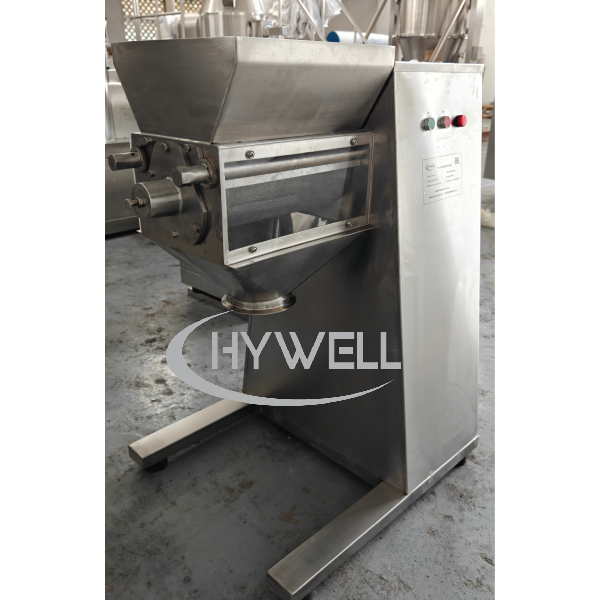
Oscillating Granulator
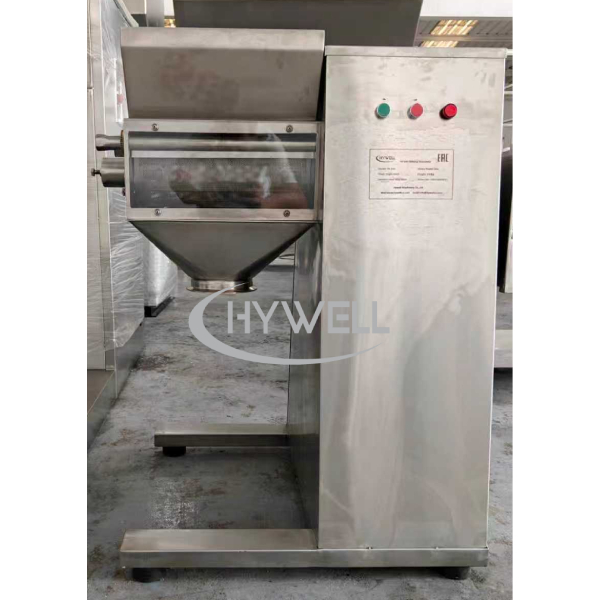
Swing Granutalor
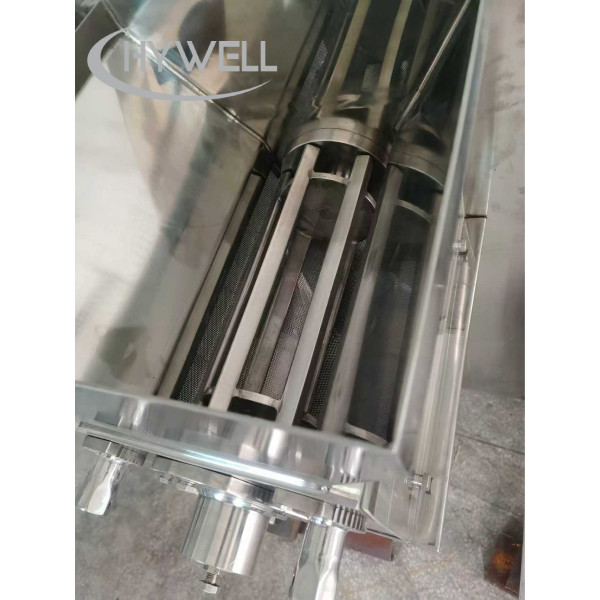
Swinging Granulation
3. Industrial Applications
3.1 Pharmaceutical Industry
In the pharmaceutical sector, granule quality directly affects tablet uniformity, dissolution rate, and bioavailability. Oscillating granulators are employed to produce granules for:
· Tablets: Uniform granules enhance compressibility and reduce coating defects.
· Capsules: Granule size and density control dosing accuracy and capsule filling efficiency.
· Oral powders: Controlled moisture and particle uniformity improve solubility and patient compliance.
3.2 Chemical Industry
Chemical powders such as fertilizers, detergents, and catalysts benefit from swing granulation due to improved flowability, reduced dust, and enhanced storage stability.
3.3 Food Industry
Food powders such as instant beverages, protein powders, flavorings, and nutritional supplements require granules with uniform size, low moisture content, and excellent solubility. Swinging Granulation meets these requirements by ensuring granules dissolve easily, resist clumping, and maintain consistent quality during storage.
3.4 Advanced Materials
Granulation technology is also critical for advanced materials, including ceramics, pigments, and functional powders. Uniform granules improve packing density, sintering behavior, dispersion, and coating performance.
4. Practical Implementation Tips
4.1 Parameter Optimization
Fine-tune oscillation frequency, amplitude, and angle according to material properties.
Adjust binder type, spray rate, and distribution to balance adhesion and granule growth.
4.2 Material Handling
Ensure uniform feeding to prevent segregation or uneven granule formation.
Use pre-conditioning (e.g., drying or sieving) for hygroscopic powders.
4.3 Monitoring and Control
Integrate sensors to measure moisture content, granule size, and temperature.
Apply automated feedback to maintain consistent quality and reduce manual intervention.
4.4 Maintenance and Hygiene
Schedule regular cleaning and inspections, particularly for pharmaceutical and food applications.
Use modular components and stainless steel construction to simplify sanitation and reduce downtime.
4.5 Process Flow and Scientific Principles
The oscillating granulation workflow consists of the following stages:
· Powder Feeding: Raw powders are delivered uniformly using hoppers or screw feeders.
· Binder Application: Precise liquid binder spraying ensures uniform wetting of particles.
· Granule Formation: Oscillation promotes particle adhesion, aggregation, and consolidation.
· Screening and Size Control: Sieves remove undersized or oversized granules to achieve desired distribution.
· Drying: Granules are dried in tray dryers, fluidized beds, or conveyor dryers to achieve optimal moisture content.
· Downstream Processing: Dried granules are compressed, encapsulated, coated, or blended for final product use.
Scientific Principle: Oscillatory motion generates shear and collision forces that influence particle aggregation. Granule characteristics, including size, density, and morphology, directly affect compressibility, flowability, solubility, and stability. Controlling these parameters ensures consistent product performance and manufacturability.
5. Innovations and Future Trends
5.1 Automation and Intelligent Control
Modern oscillating granulators integrate sensors for real-time monitoring of granule size, moisture, temperature, and oscillation parameters. Automated feedback control systems adjust oscillation frequency, binder flow, and drying conditions to maintain consistent granule quality with minimal human intervention.
5.2 Continuous Manufacturing Integration
Swing granulation can be incorporated into continuous production lines, reducing batch-to-batch variability and improving throughput. Continuous processes are particularly advantageous for pharmaceuticals and food powders, where consistent quality and reduced downtime are essential.
5.3 Sustainability and Environmental Efficiency
Sustainable manufacturing initiatives include:
· Reducing energy and water consumption
· Minimizing material waste
· Utilizing environmentally friendly binders
· Optimizing equipment design for lower emissions
These measures align rotary swing granulator with global sustainability goals, reducing operational costs while enhancing corporate responsibility.
5.4 Advanced Material Adaptation
New designs accommodate sensitive, high-activity, or hygroscopic powders, expanding swing granulation applications in pharmaceuticals, chemicals, and functional foods. Precision control ensures granules maintain structural integrity, chemical stability, and solubility characteristics.
6. Conclusion
Oscillating granulators, represents a cornerstone of modern granule production. By integrating precise oscillatory motion, controlled binder application, and sophisticated process monitoring, these technologies deliver consistent, high-quality granules across multiple industries.
The benefits are clear:
· Uniform granule size and density improve flowability, compressibility, and solubility.
· Energy-efficient operation reduces operational costs and environmental impact.
· Versatility allows processing of fragile, sticky, or hygroscopic powders.
· Dust and waste reduction enhances workplace safety and regulatory compliance.
· Ease of maintenance minimizes downtime and supports stringent hygiene standards.
With increasing industrial demands for precise, efficient, and sustainable granulation, oscillating granulators are positioned to become the standard solution for pharmaceutical, chemical, food, and advanced material manufacturers worldwide.

 Русский
 English
 العربية
 Français
 Español
 Português
 Deutsch
 italiano
 日本語
日本語 한국어
한국어 Nederlands
 Tiếng Việt
 ไทย
ไทย Polski
 Türkçe
 ພາສາລາວ
 Bahasa Melayu
 Filipino
 Bahasa Indonesia
 magyar
 Română
 Čeština
 қазақ
қазақ Српски
 हिन्दी
 فارسی
فارسی Slovenčina
 Slovenščina
 Norsk
Norsk Svenska
 українська
 Ελληνικά
 Suomi
Suomi Հայերեն
 עברית
עברית Dansk
Dansk اردو
اردو বাংলা
বাংলা Hrvatski
 Afrikaans
 Gaeilge
 Eesti keel
 Māori
Māori नेपाली
 Oʻzbekcha
 latviešu
 Azərbaycan dili
 Беларуская мова
 Български
 ქართული
 Kurdî
Kurdî Кыргызча


 简体中文
简体中文